
Declutter before moving: a homeowner's guide
TL;DR:
- Decluttering before moving reduces costs, stress, and physical effort by encouraging thoughtful decision-making. Starting 6 to 8 weeks prior with a structured schedule and efficient systems ensures a lighter, more manageable move. Using the move-out method and mindful routines helps create an intentional home while saving money and mental clarity.
Moving is one of the most stressful events in adult life, but most of that stress is self-inflicted. Every item you carry into a moving truck is an item you chose to keep, pack, label, transport, unload, and find a place for. When you declutter before moving, you shrink the entire problem. Fewer boxes mean lower costs, faster packing, and a new home that starts fresh instead of inheriting the chaos of your last one. This guide walks you through every step, from timing to final checks, so you arrive lighter in every sense.
Key Takeaways
| Point | Details |
|---|---|
| Start early | Begin decluttering at least 6 to 8 weeks before your move to ensure plenty of time for decisions and disposal. |
| Use a system | Organize belongings into keep, donate, trash, and storage bins to make sorting manageable and clear. |
| Declutter room-by-room | Focus on one room or category at a time to avoid overwhelm and keep progress steady. |
| Apply the move-out method | Simulate moving by emptying spaces and deciding item value to prevent keeping unnecessary things. |
| Lighter load saves money | Reducing volume and weight before moving cuts costs and makes packing and unpacking easier. |
When to start decluttering before your move
Timing is everything. If you start decluttering the week before the movers arrive, you will make rushed, regrettable decisions. Start decluttering 6 to 8 weeks before moving day to give yourself room for thoughtful choices and logistical scheduling. That timeline also lets you arrange donation pickups, schedule junk removal, and list items for sale without scrambling.
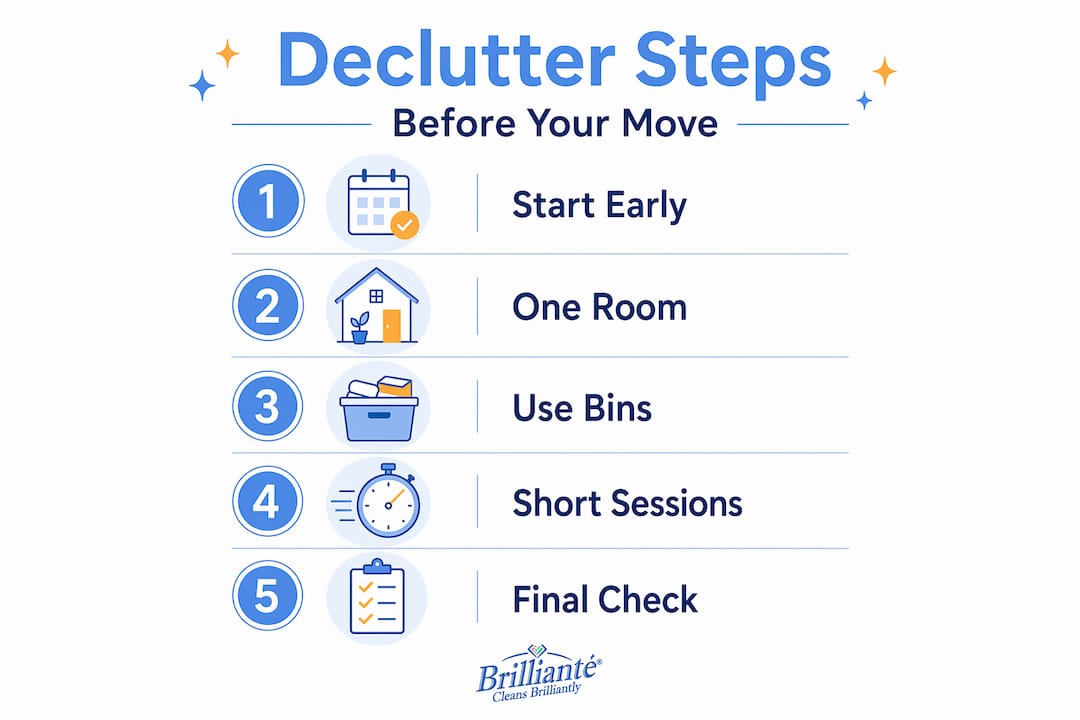
A structured weekly schedule works far better than random bursts of effort. Tackle one room per week, then shift to category-based sorting (clothing, books, kitchen tools) in the final weeks. This prevents decision fatigue, which is the mental exhaustion that leads to “I’ll just take it and sort it later,” which never happens.
Aim to complete your sorting 3 to 4 weeks before moving day. That window gives you time to responsibly get rid of what you’ve sorted and start packing with only what you actually want in your new home. The benefits of decluttering go far beyond a lighter truck load.
A simple 6-week decluttering timeline:
- Weeks 6 to 5: Storage areas, garage, basement, attic
- Weeks 4 to 3: Bedrooms, closets, bathrooms
- Week 2: Kitchen, living room, home office
- Week 1: Final review, donate/dispose of sorted items, begin packing
Key principles to hold to that schedule:
- Block specific time on your calendar rather than waiting for motivation
- Start with easy, low-emotion spaces to build momentum
- Tell someone your timeline so you stay accountable
- Book donation pickups and junk removal before you need them
Tools and systems to declutter efficiently
The biggest reason decluttering stalls is not laziness. It is the lack of a clear system. Without a system, you pick up an item, feel unsure, set it down, and move on. A 4-bin sorting system — keep, donate or sell, trash or recycle, and storage — turns every decision into a physical action. Once you touch something, it goes in a bin. No putting it back.

The storage bin is the one to watch. It should be small and temporary. Anything in it needs a final decision before packing day arrives. Leaving that bin open-ended is how “storage” becomes “moved clutter in a new location.”
Daily 10 to 20 minute sessions are more sustainable than marathon weekend efforts. A short checklist for each session keeps you focused and gives you a concrete sense of progress. Consistent small actions build habits that outlast any single burst of energy.
Sorting system comparison at a glance:
| Method | Best for | Risk |
|---|---|---|
| 4-bin system | Clear, fast decisions | Storage bin can grow |
| Category-based (KonMari style) | Emotional items, clothing | Time-consuming |
| Room-by-room | Logical, spatial thinkers | May miss cross-room duplicates |
| Box-and-wait | Uncertain items | Easy to forget and move the box |
What you need before your first session:
- Four clearly labeled bins or boxes
- Trash bags in two sizes
- A notepad for items to sell or donate
- A timer set to your session length
Pro Tip: Work top to bottom within every room. Clear high shelves first so debris falls down rather than onto already-sorted areas. It sounds minor until you spend 20 minutes re-sorting a shelf you already cleared.
Combining good timing with good tools, and understanding the deeper decluttering benefits and routines, sets you up for room-by-room success.
Room-by-room decluttering: practical strategies
Every room has its own logic. Fighting that logic wastes time. Start with low-emotion, high-volume spaces like the garage, storage closets, and the basement. These areas hold broken tools, duplicate holiday decorations, and items you forgot you owned. The wins come fast, which builds the confidence you need for harder spaces.
Bathroom: Throw out expired toiletries and old medications. Medicines should be disposed of at a pharmacy drop box, not in the trash or toilet. If you haven’t opened a product in a year, it goes.
Bedroom: Use the reverse hanger method. Turn all your hangers backward. After one month, anything still backward gets donated. It is a simple, objective test that sidesteps the “but I might wear it” conversation. Expired products, broken items, and duplicates are always the first to go in every room.
Kitchen: Duplicate gadgets are the silent culprits. Do you need three spatulas? Two can openers? An ice cream maker you used twice? Clear expired pantry items, damaged cookware, and anything you only kept because you paid for it.
Living room: Outdated electronics, tangled cables for devices you no longer own, and decorative items you display out of habit rather than love all belong in the donate or trash bin.
Pro Tip: Before deciding whether to move any large piece of furniture, measure it against your new home’s floor plan. Moving a couch that doesn’t fit your new living room costs you money twice: once to move it and once to remove it. Check out these organizing home office tips for handling that specific room with care.
Quick room-by-room action steps:
- Garage and storage: Remove anything broken, outdated, or duplicated
- Bathroom: Discard all expired products and old medications
- Bedroom: Apply the reverse hanger method; remove unused shoes
- Kitchen: Cut duplicates and clear expired food items
- Living room: Remove outdated tech, cables, and decor you no longer love
- Home office: Shred old documents; digitize what you can
The move-out method: a powerful decluttering mindset
Here is where most people go wrong. They sort around their belongings instead of removing everything and starting from zero. The move-out method flips that.
The move-out method involves setting a strict deadline and emptying spaces fully before deciding what goes back in. Pull everything out of a closet, a drawer, or a room and place it on a surface. Now you are looking at the full reality of what you own, not the curated version that hides behind closed doors.
The question you ask about every item is honest and practical:
“Would I pack this, haul it, and find dedicated space for it in a much smaller home?”
If the answer is no, it doesn’t belong. Not because it is worthless, but because its value does not justify the cost of keeping it.
How to run the move-out method effectively:
- Set a firm deadline for each session, even if you are not moving yet
- Empty the entire space before touching anything
- Group similar items together on the floor or a table
- Ask the “smaller home” question for every item
- Use the cardboard box test: put uncertain items in a sealed box with a date. If you haven’t opened it in 30 days, donate it without looking inside.
Pro Tip: The move-out method is especially useful for sentimental spaces like a home office or a spare room that has become a catch-all. The act of emptying the space changes your relationship to the stuff in it. You stop seeing “my things” and start seeing “items I need to justify keeping.”
How decluttering saves money and reduces stress on moving day
Moving companies charge by time, weight, and volume. That formula means every unnecessary box is a direct, measurable cost. Removing 500 to 1,000 pounds of items can save hundreds of dollars on a long-distance move. That is not a rounding error. That is real money.
Moving costs scale with volume and weight, so every bag of donations you drop off before packing day is money back in your pocket. Fewer boxes also means faster loading and unloading, which reduces hourly labor charges on top of the weight savings.
What decluttering saves you:
| Category | Potential savings |
|---|---|
| Weight reduction (500 to 1,000 lbs) | $200 to $600+ on long-distance moves |
| Fewer boxes | Reduced packing materials and labor hours |
| No post-move disposal | Saves renting a dumpster or hiring a junk service |
| Faster unpacking | Less time in limbo, lower mental stress |
Beyond money, there is a less-discussed benefit. Packing a cluttered home is exhausting in a way that packing a streamlined one is not. When you look at a room full of sorted, intentional belongings, packing feels manageable. When you look at years of accumulated stuff, it feels impossible. The mental and emotional benefits of decluttering are real and measurable, particularly during a high-stress event like a move.
One trap to avoid: do not pack items you already know you plan to discard. People do this constantly. They pack a broken lamp because they “don’t have time to deal with it,” then throw it out upon arrival. You paid to move garbage.
Maintaining momentum: daily routines and mistakes to avoid
Burnout is the single biggest reason decluttering projects stall. Daily 10 to 20 minute sessions prevent the exhaustion that kills motivation. You do not need to empty a room in a single afternoon. You need to make consistent decisions every day until the job is done.
Schedule heavier work, like the garage or storage rooms, on weekends when you have more time. Keep weeknight sessions to simpler tasks like clearing bathroom cabinets or sorting a single drawer. Matching task size to available time removes the excuse of not having enough time.
Avoid keeping an open “maybe” pile for too long. That pile is where objects go to survive another move. Give every item a home in one of your four bins before packing day.
Common decluttering mistakes that cost you:
- Saving sentimental spaces for last and then rushing them under deadline pressure
- Creating a “storage” bin with no firm plan or end date
- Decluttering room by room but ignoring cross-room duplicates
- Not scheduling donation pickups and letting bags pile up
- Skipping small spaces like junk drawers or linen closets
Pro Tip: Celebrate real milestones. Finished the garage? Reward yourself. Cleared the entire kitchen? That deserves acknowledgment. Small celebrations keep the energy alive for the spaces still ahead. Also explore these sustainable decluttering routines for habits that extend well beyond moving day.
Verifying your decluttering: final checks before packing
You have sorted, donated, and discarded. Before you pack a single box, run a final verification pass. Professional organizers recommend measuring new spaces and confirming that furniture you plan to move will actually fit. This one step prevents the expensive mistake of transporting large items that have no place in your new home.
Final pre-packing verification checklist:
- Walk every room with your bins and make any last-call decisions
- Measure all furniture against your new home’s floor plan
- Schedule donation pickups before packing day begins
- Book junk removal for anything that cannot be donated
- Handle electronics and hazardous items responsibly
When it comes to outdated electronics, responsible disposal matters. Old monitors, printers, and televisions contain materials that do not belong in landfills. Check out these tips for recycling old electronics before your move.
Final room checks should cover:
- Junk drawers (every home has at least two)
- Linen closets and bathroom cabinets
- The tops of wardrobes and refrigerators
- Under beds and inside ottomans
- Garage shelving and basement corners
Label every box by room and contents as you pack. It sounds obvious, but “Misc” boxes become expensive time wasters on unpacking day. Specific labels like “Kitchen, small appliances” or “Bedroom 2, winter bedding” save hours.
Why decluttering before moving is your best investment in peace of mind
Here is the opinion most moving guides will not give you: the physical act of sorting your belongings is less important than the mindset shift that makes it possible.
Most people approach decluttering as a cost. It takes time. It involves decisions. It stirs up emotions. But reframing decluttering as a return on investment question changes everything. The question is not “do I like this?” It is “is this item worth the money, time, and space it costs to keep?”
That framing cuts through sentiment and justification faster than any organizing method. A lamp you vaguely like is easy to keep. A lamp that costs $80 to move, requires a specific corner in your new home, and that you have walked past without noticing for two years is easy to let go when you view it through that lens.
Moving is one of the few moments in adult life when you are forced to physically account for every object you own. That is a rare and genuinely valuable opportunity. Most people rush past it. The ones who use it to question what they actually want surrounding them arrive at their new home with something better than a lighter truck: they arrive with genuine mental clarity and a home that was built intentionally rather than accumulated accidentally.
Letting go of guilt is part of the work. The bread maker you never used, the gifts you kept out of obligation, the books you will not re-read but feel you should keep because you read them once. These objects carry emotional weight that costs you every day you live around them. A move is the most natural exit ramp those objects will ever get. Use it.
Make your move lighter with Brilliante Crystal Chandelier Cleaner
When you finally move into your new home, you want it to look and feel immaculate from day one. That includes the fixtures and lighting that set the tone for every room. If your new space has a crystal chandelier, or if you are bringing yours along, do not let moving grime follow it.

Brilliante Crystal Chandelier Cleaner makes keeping your chandelier brilliant effortlessly simple. Just spray and let it drip dry. No wiping, no disassembly, no harsh chemicals. It is non-abrasive, environmentally friendly, and safe on metal components. Rated number one by hundreds of satisfied customers and proudly made in the USA, it is the kind of product that fits perfectly into a freshly decluttered, thoughtfully arranged new home. Pair it with your stress-reducing decluttering habits and responsible electronics recycling to start your new chapter the right way.
Frequently asked questions
When is the best time to start decluttering before moving?
Start at least 6 to 8 weeks before moving day to allow time for thoughtful decisions and logistics, finishing your main sorting about 3 to 4 weeks out so you can arrange donations and removal without rushing.
What items should I always get rid of before moving?
Expired items, broken goods, and duplicates are the first to go, along with unworn clothing, outdated electronics, and anything you would not consciously choose to place in a new home.
How does decluttering save money when moving?
Cutting 500 to 1,000 pounds of excess items can save hundreds of dollars in transportation costs on a long-distance move, plus reduce labor hours and the need for post-move junk removal.
What is the move-out method for decluttering?
The move-out method means setting a firm deadline, emptying a space completely, and deciding what earns its way back in, simulating real moving pressure to force clear, decisive choices rather than vague postponements.