
Eco-friendly ways to prevent hard water stains on chandeliers
TL;DR:
- Hard water stains on chandeliers are caused by mineral deposits from high-calcium and magnesium water, which diminish sparkle and are hard to remove once formed. Prevention involves systematic cleaning, applying eco-friendly hydrophobic coatings, and installing water softeners to reduce mineral adhesion. Regular inspections and proactive maintenance are essential for long-lasting crystal brilliance and environmental sustainability.
You clean your crystal chandelier, step back to admire it, and there they are again — those hazy white spots dulling every piece of crystal. Hard water stains on a chandelier feel like a losing battle, especially when they reappear just days after a thorough cleaning. The good news is that prevention, not repetitive scrubbing, is the smarter approach. With the right eco-friendly tools and a consistent routine, you can protect your chandelier’s brilliance, cut down on cleaning time, and reduce your household’s reliance on harsh chemical products.
Key Takeaways
| Point | Details |
|---|---|
| Immediate drying matters | Wipe crystals with microfiber cloths right after cleaning to prevent mineral spots before they start. |
| Hydrophobic coatings help | Applying water-repelling sealants reduces both stains and future cleaning time. |
| Whole-home softeners work | Water softeners address hard water at the source, making chandeliers and all fixtures easier to maintain. |
| Routine checks ensure results | Regular inspections help you catch and resolve stains before they become difficult to remove. |
| Eco-friendly methods last | Sustainable products minimize chemical use while keeping your chandelier brilliant and spot-free. |
What causes hard water stains on crystal chandeliers?
Understanding the science behind these stains is essential before tackling how to prevent them.
Hard water is simply water that carries a high concentration of dissolved minerals, primarily calcium and magnesium. These minerals are picked up as water travels through rock and soil before reaching your home’s pipes. When hard water lands on a crystal surface and then evaporates, the water disappears but those minerals stay behind, bonding to the crystal and forming the chalky white deposits most homeowners recognize immediately.
Chandeliers are especially vulnerable for two reasons. First, their complex shapes, curves, prisms, and dangling pendants create countless small surfaces where water can pool and evaporate slowly. Second, crystal’s natural clarity and light-refracting properties actually make even minor mineral deposits far more visible than they would be on an opaque surface. Even a thin layer of calcium buildup scatters and blocks light, instantly diminishing the sparkle you paid for. It is worth noting that distinguishing crystal from glass can also help you choose the right prevention method, since each material has slightly different surface characteristics.
Here is a quick look at how hard water hardness levels compare across common household sources:
| Water source | Hardness level | Stain risk |
|---|---|---|
| Municipal tap water (average) | 100-200 mg/L | Moderate |
| Well water | 200-400+ mg/L | High |
| Recirculated HVAC moisture | 50-150 mg/L | Low to moderate |
| Filtered or softened water | Below 50 mg/L | Very low |
Common household sources that expose chandeliers to hard water include steam from nearby HVAC vents, humidifiers, cooking vapors drifting from open kitchens, and direct cleaning with untreated tap water. To install a whole-home water softener that removes calcium and magnesium ions prevents hard water stains at the source across all fixtures, including your chandelier.
Key mineral culprits to know:
- Calcium carbonate: The primary source of white crusty scale
- Magnesium bicarbonate: Adds to scale thickness and cloudiness
- Silica: Creates a harder, glassier deposit that resists cleaning
- Iron traces: Can add a yellow or rust-colored tint to stains
Essential tools and eco-friendly materials for prevention
Once you recognize why stains form, gathering the right supplies makes prevention far easier and more sustainable.
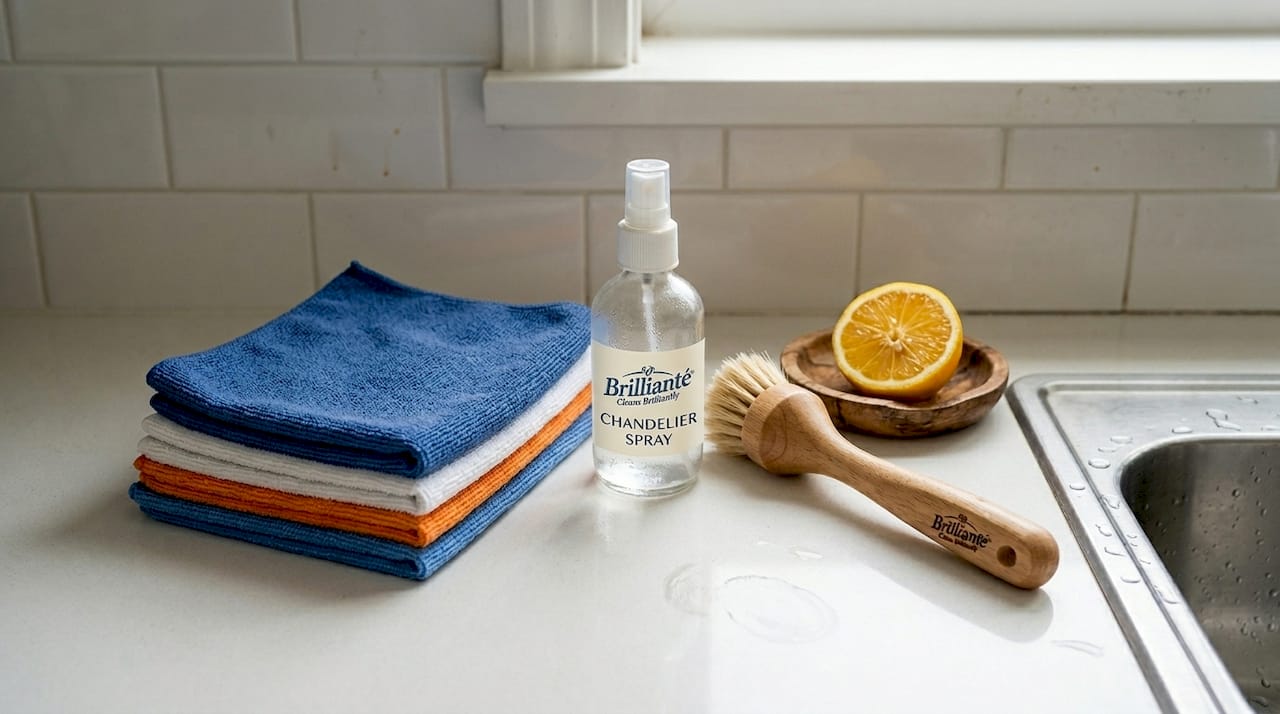
You do not need an arsenal of toxic products to protect your chandelier. In fact, many of the most effective prevention tools are also the most environmentally friendly. The goal here is to reduce mineral adhesion, speed up drying, and maintain a protective barrier on each crystal surface. Choosing sustainable options means fewer chemicals going down your drain, less packaging waste, and a safer environment for your family and pets.
Applying hydrophobic coatings to crystal surfaces repels water and reduces mineral adhesion, which is one of the smartest long-term prevention moves available. Products such as Rain-X or car wax create a barrier that causes water to bead and roll off rather than sitting and evaporating on the surface.
| Tool or material | Purpose | Eco-friendly option |
|---|---|---|
| Microfiber cloths | Lint-free drying and polishing | Reusable, washable |
| Hydrophobic spray or wax | Repels water and minerals | Low-VOC formulas available |
| Distilled water in spray bottle | Residue-free rinsing | No packaging waste |
| White vinegar solution | Natural mineral dissolvent | Biodegradable |
| Eco-friendly chandelier spray | Regular light cleaning | Plant-based, non-toxic |
To properly clean and preserve chandeliers long-term, the combination of a quality drip-dry cleaner with preventive wiping after every exposure to moisture is the most reliable routine you can adopt.
Must-have materials at a glance:
- Lint-free microfiber cloths in multiple sizes
- Distilled water for final rinses
- A plant-based, non-abrasive crystal cleaner
- A hydrophobic coating product rated safe for glass or crystal
- A stable step ladder for safe access to every crystal
Pro Tip: Never use paper towels on crystal. They leave behind tiny scratches over time that actually make mineral deposits stick faster. Stick with high-quality microfiber cloths only.
Step-by-step: How to prevent hard water stains on chandeliers
With materials at the ready, you can easily adopt these steps as part of your chandelier care routine.
Prevention is most effective when it is systematic rather than occasional. A rushed clean once a month does far less good than a quick, thoughtful routine every couple of weeks. Here is how to build one:
-
Turn off and cool the fixture. Always let your chandelier sit unused for at least 30 minutes before touching it. Hot bulbs and electrical components need time to cool completely before any cleaning takes place.
-
Lay a soft drop cloth or towel beneath the chandelier. This catches any drips and protects your floor or furniture from moisture and cleaning solutions during the process.
-
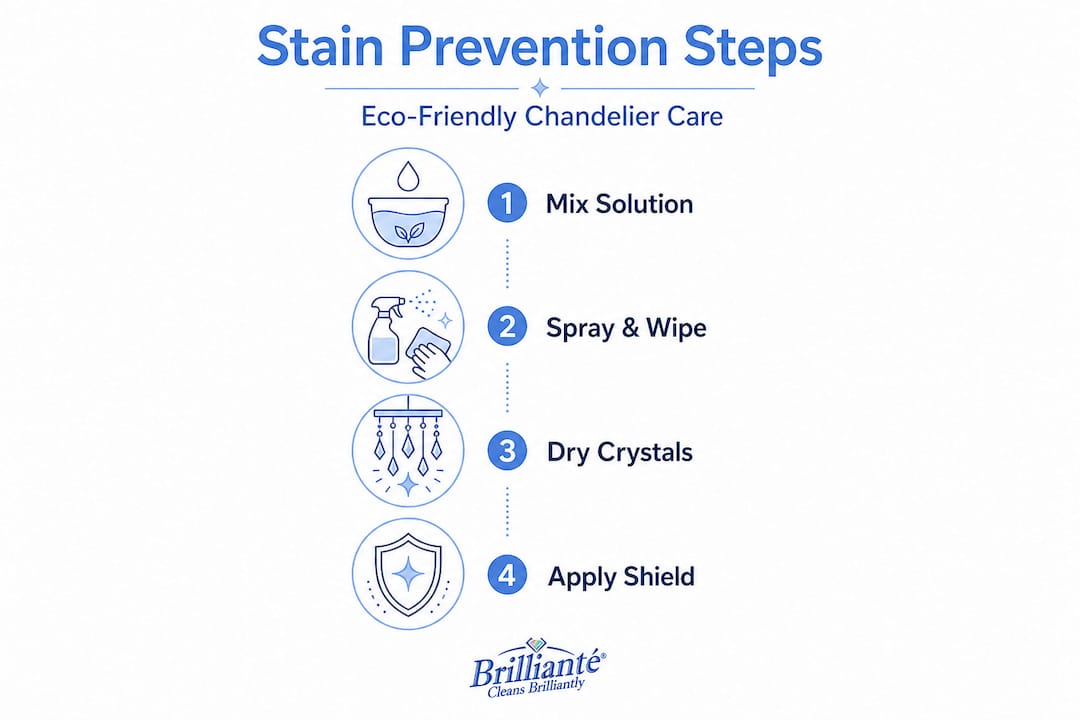
Spray your eco-friendly crystal cleaner on each section. Work from the top of the fixture downward so any drips land on unprocessed crystals rather than ones you have already treated. Allow the product to do its job and drip away naturally.
-
Dry crystals immediately with lint-free microfiber cloths after any water exposure to avoid water spots. This single step alone dramatically reduces mineral deposit formation because you eliminate the evaporation window that allows minerals to bind.
-
Apply a hydrophobic coating after cleaning. Follow the manufacturer’s instructions carefully. Buff in small circular motions with a clean microfiber cloth, allowing the protective film to set fully before turning the fixture back on.
-
Inspect each crystal section under good direct light. Tilt individual pendants slightly to catch light from different angles, revealing any spots your cleaning may have missed.
-
Consider a whole-home water softener for lasting results. Water softeners cut buildup by up to 80% and reduce flow reduction in pipes by 40%. This whole-home benefit means your chandelier and all your other fixtures stay cleaner between maintenances. For guidance on removing water marks from chandeliers when prevention does not fully prevent a stain, there are targeted solutions available.
Pro Tip: Set a calendar reminder every two weeks for a quick microfiber wipe-down. It takes under ten minutes and stops mineral buildup from ever getting a foothold.
“The most effective prevention strategy is the one you will actually do consistently. A two-minute wipe after every exposure to moisture beats an hour-long deep clean after months of neglect.”
Advanced fixes: Whole-home solutions and protective coatings
If spot treatments are not enough, more comprehensive preventive measures can make elegance nearly effortless.
Some homes have exceptionally hard water, particularly those on well systems or older municipal supplies. In those cases, even diligent wiping may not be enough to keep crystals sparkling. That is when it is time to look at solutions that treat the problem at the source rather than at the surface. Learning how to remove film from crystal chandeliers is helpful, but making that film appear less often is the real long-term win.
Installing a whole-home water treatment system is the single highest-impact move for any homeowner dealing with persistent hard water. Modern water softeners reduce scale buildup, improve system efficiency by using up to 50% less salt and 28% less water in newer models, and significantly extend the life of appliances and fixtures. You can explore a range of whole-home water treatment options to find systems suited to different water hardness levels and household sizes.
| Prevention method | Scale buildup reduction | Maintenance frequency | Eco impact |
|---|---|---|---|
| Regular microfiber wiping | Moderate (30-40%) | Every 2 weeks | Very low |
| Hydrophobic coating | High (50-60%) | Every 6 months | Low |
| Whole-home water softener | Very high (up to 80%) | Annual maintenance | Low to moderate |
| Salt-free water conditioner | Moderate to high (40-60%) | Minimal | Very low |
Pro Tip: If you want to minimize your environmental footprint, look specifically for salt-free water conditioners or magnetic descalers. They use no chemicals, produce no wastewater, and require very little ongoing maintenance while still making a real difference in how hard your water is.
Protective coatings, applied after every cleaning session, act as an invisible shield on each crystal. The hydrophobic effect means water beads up and rolls off instead of clinging to the surface and evaporating. This does not make your chandelier completely immune to staining, but it slows the process dramatically, turning what might be a monthly problem into a twice-yearly one.
Verification: How to check your chandelier stays stain-free
Even with the best prevention measures, continual verification ensures your efforts pay off.
Prevention only works if you check your results and adjust when needed. Stains can still form if a coating wears thin, if your water conditions change seasonally, or if you miss a section during application. Regular inspections are what separate homeowners who maintain lasting sparkle from those who face heavy cleaning sessions every few months.
What to look for during visual inspections:
- Hold a flashlight or phone light at a low angle across the crystal surface to reveal any hazy patches
- Look for white or gray spots, not just at the tips of pendants but along connecting wires and metal frames
- Check for rainbow distortion: if crystals are not refracting light cleanly, mineral film is likely present
- Inspect areas closest to HVAC vents or ceiling fans, as airflow accelerates moisture evaporation and stain formation
How often should you check?
For most homes, a visual inspection every two to three weeks is sufficient. Homes with very hard water or high-humidity environments may benefit from weekly spot checks. Using the strategy of prevention over removal with a whole-home softener addresses the root cause and reduces how often you need to inspect at all.
For a full breakdown of verifying water mark removal when spots do appear, step-by-step guidance can help you tackle them before they bond permanently to the crystal.
| Prevention step | Expected result | Check frequency |
|---|---|---|
| Regular microfiber wiping | Minimal spotting | Every 2 weeks |
| Hydrophobic coating applied | Water beading visible | Every 6 months |
| Water softener installed | Near-zero scale buildup | Annually |
| Eco-friendly cleaner used | No chemical residue | Every cleaning |
Signs your routine is working:
- Crystals refract light in sharp, clear rainbow patterns
- No visible white haze or cloudiness on pendants
- Metal frames remain clean and untarnished
- Cleaning sessions feel quicker and easier each time
Why eco-friendly, proactive care beats constant cleaning
After learning the technical how-to, it is helpful to reframe your mindset for lasting elegance.
Here is something most chandelier care advice skips over entirely: the problem is not that homeowners are lazy about cleaning. It is that they are cleaning reactively instead of preventing proactively. Most people wait until their chandelier looks dull, then spend an hour scrubbing with whatever cleaner is under the sink, often with products that are too harsh, too chemical-heavy, and ultimately too short-sighted to make a real difference.
We have seen this cycle play out over and over. The chandelier looks beautiful for a week, then the spots return, then comes another round of cleaning and frustration. The solution has never been a better scrubbing technique. It has always been reducing the mineral load that reaches the crystal in the first place, and then creating a surface barrier so that whatever minerals do make contact have a far harder time sticking around.
The environmental case for proactive care is just as strong as the practical one. Repeated use of chemical-based cleaners adds up fast, both in cost and in environmental load. Many conventional products contain phosphates and synthetic surfactants that do not fully break down in wastewater systems. Switching to an eco-friendly cleaner and backing it up with physical prevention strategies, like hydrophobic coatings and water softeners, cuts your chemical usage dramatically over a year’s time.
There is also a financial argument that rarely gets made: well-maintained crystal holds its clarity and value far longer. Rough cleaning, harsh chemicals, and abrasive scrubbing cause micro-scratches that accumulate over years and permanently reduce a chandelier’s brilliance. Prevention, by contrast, is gentle by nature.
For those still dealing with chandelier stain removal as an immediate need, addressing it quickly and then shifting to a prevention-first routine is always the right move. The goal is to make this the last time a hard water stain catches you off guard.
Discover crystal-safe cleaning for lasting beauty
Protecting your chandelier from hard water stains gets so much easier when your cleaning products work with your prevention routine, not against it. Brilliante Crystal Chandelier Cleaner is proudly made in the USA, formulated to be environmentally friendly, non-abrasive, and completely safe for metal components. The drip-dry formula means you simply spray and walk away, making it a natural fit for any hands-off, prevention-focused routine.

Whether you are applying a protective coating, doing your biweekly wipe-down, or addressing a stubborn spot before it sets, having the right cleaner in hand makes every step faster and more effective. To get the most from your care routine, explore expert guidance on how to safely remove water marks and keep your crystal looking showroom-perfect year round. Rated number one by hundreds of satisfied customers, Brilliante is the trusted choice for homeowners who refuse to settle for anything less than brilliance.
Frequently asked questions
How often should I apply a hydrophobic coating to my chandelier?
Most hydrophobic coatings last six to twelve months on crystal surfaces; reapply every six months for consistent protection against water and mineral adhesion.
Does a water softener eliminate all hard water stains?
A water softener cuts buildup by up to 80% but may not eliminate every stain, so regular drying and visual inspections remain an important part of your routine.
Are eco-friendly chandelier cleaners as effective as chemical-based ones?
Eco-friendly cleaners perform just as well when you pair them with preventive care like hydrophobic coatings and consistent microfiber drying after every cleaning.
What if stains form even after prevention steps?
Revisit your coating coverage and check for overlooked hard water sources. You can also install a water softener to remove calcium and magnesium at the source, and consider a professional cleaning if deposits have already bonded firmly to the crystal surface.