
What is lead crystal: guide to elegant chandeliers
Lead crystal has graced elegant homes for centuries, yet many homeowners and decorators remain uncertain about what it actually is and whether it belongs in modern interiors. Despite its name, lead crystal isn’t a true crystal at all, but rather a type of glass containing at least 24% lead oxide, which gives it extraordinary brilliance and weight. This guide clarifies the composition, properties, and practical considerations for choosing lead crystal chandeliers and décor, helping you make informed decisions about incorporating these timeless pieces into your home.
Key takeaways
| Point | Details |
|---|---|
| Composition standard | Lead crystal contains minimum 24% lead oxide, with some full lead variants reaching 30% for enhanced properties. |
| Optical brilliance | High refractive index up to 1.7 creates prismatic sparkle and light dispersion ideal for chandeliers. |
| Safety limitations | Not safe for food or drink due to lead leaching; best reserved for decorative applications only. |
| Authenticity markers | Handcrafted pieces display small bubbles and refractive variations signaling genuine craftsmanship. |
| Modern alternatives | Lead-free crystal using barium or zinc oxide offers similar aesthetics with improved safety profiles. |
Understanding lead crystal: composition and history
Lead crystal represents a significant advancement in glassmaking that transformed decorative arts. The material earned its name from the substantial lead oxide content of at least 24% that distinguishes it from ordinary glass. Higher quality variants, often labeled as full lead crystal, contain up to 30% lead oxide by weight, further enhancing the material’s distinctive characteristics.

George Ravenscroft invented lead crystal in 1680s England, solving persistent problems with glass clarity and workability that plagued craftsmen of the era. His breakthrough discovery involved adding lead oxide to the traditional glass mixture of silica, potash, and other minerals. This innovation fundamentally altered the material’s properties, lowering the melting point and making the glass softer and more receptive to intricate cutting and engraving.
The addition of lead oxide transformed glassmaking in several crucial ways:
- Reduced melting temperature allowed artisans to work the material longer before it hardened
- Increased malleability enabled deeper cuts and more elaborate decorative patterns
- Enhanced optical properties created unprecedented brilliance and light refraction
- Greater weight provided a substantial, luxurious feel that signaled quality
Early applications focused on tableware for wealthy patrons, but craftsmen quickly recognized the material’s potential for decorative lighting. The prismatic qualities that made lead crystal drinking glasses sparkle proved even more dramatic when applied to chandeliers, where multiple faceted pieces could scatter candlelight throughout grand rooms. By the 18th century, lead crystal chandeliers had become status symbols in European palaces and manor houses, establishing a tradition of elegance that continues today.
Key properties of lead crystal that enhance décor appeal
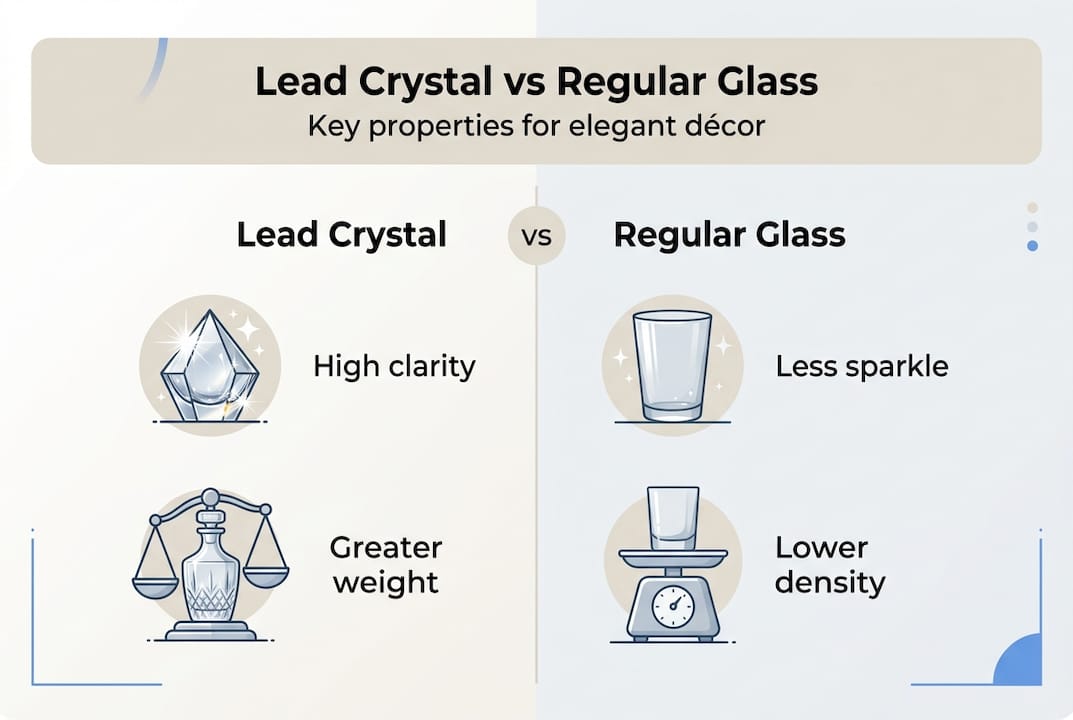
The physical characteristics of lead crystal create visual effects that regular glass simply cannot match. Understanding these properties helps explain why discerning homeowners and decorators continue to prize lead crystal for statement lighting and decorative accents.
| Property | Lead Crystal | Regular Glass |
|---|---|---|
| Refractive Index | 1.6 to 1.7 | 1.5 |
| Density | 3.1 g/cm³ | 2.4 to 2.8 g/cm³ |
| Light Dispersion | High prismatic effect | Minimal |
| Sound Quality | Clear resonant ping | Dull thud |
The high refractive index of up to 1.7 stands as lead crystal’s most celebrated feature. This optical property determines how dramatically light bends when passing through the material. Higher refractive indices create more pronounced light dispersion, splitting white light into rainbow spectrums similar to how a prism works. When sunlight or artificial light strikes a lead crystal chandelier, each faceted pendant acts as a miniature prism, casting dancing patterns of color across walls and ceilings.
Density contributes significantly to the perceived luxury of lead crystal pieces. At approximately 3.1 g/cm³, lead crystal weighs noticeably more than standard glass, giving it a substantial, premium feel. This weight signals quality to anyone who handles the material, but it also creates practical considerations. A large lead crystal chandelier can weigh 50 to 100 pounds or more, requiring robust ceiling support and professional installation to ensure safety.
The lower melting point of lead crystal, while beneficial during manufacturing, enables the intricate hand-cut designs that define premium pieces. Artisans can create deeper facets, more complex patterns, and sharper edges than possible with harder glasses. These cuts maximize light interaction, amplifying the material’s natural brilliance. Each facet becomes a tiny mirror and prism simultaneously, creating the signature sparkle that makes cleaning crystal chandeliers worthwhile to maintain their beauty.
Authentic lead crystal produces a distinctive resonant ping when gently tapped, a sound quality that results from the material’s molecular structure and density. This auditory signature provides a simple authenticity test, as regular glass produces a duller, shorter sound. The musical quality of fine lead crystal has inspired craftsmen to create crystal musical instruments and bells that showcase this unique property.
Pro Tip: Before installing a heavy lead crystal chandelier, have a structural engineer or qualified contractor verify your ceiling can support at least twice the fixture’s weight to ensure long-term safety and prevent damage.
Safety considerations and modern alternatives to lead crystal
While lead crystal’s beauty remains undisputed, its lead content raises legitimate safety questions for modern households. Understanding when lead crystal poses risks and when it remains perfectly safe helps homeowners make appropriate choices for their specific situations.
Lead can leach from crystal when it contacts acidic liquids, making lead crystal unsuitable for storing beverages, especially wine, spirits, or acidic juices. The longer liquid remains in contact with lead crystal, the more lead migrates into the drink. Studies have documented measurable lead levels in wine stored in lead crystal decanters for just a few hours. For this reason, health authorities worldwide recommend against using lead crystal for food service or beverage storage.
Decorative applications present an entirely different safety profile. Lead crystal chandeliers, vases, figurines, and other ornamental pieces pose minimal risk because they involve no food contact or liquid storage. The lead remains locked within the glass matrix under normal conditions. Occasional handling during cleaning crystal chandeliers does not create exposure concerns, as lead does not transfer through casual touch.
| Crystal Type | Appearance | Weight | Food Safety | Best Use |
|---|---|---|---|---|
| Lead Crystal | Exceptional brilliance | Heavy, substantial | Not recommended | Decorative only |
| Lead-Free Crystal | Very good clarity | Moderate weight | Fully safe | All applications |
| Regular Glass | Basic clarity | Lightest | Safe | Everyday items |
Lead-free crystal alternatives have evolved significantly, using barium oxide or zinc oxide to achieve optical properties approaching traditional lead crystal. These substitutes create similar refractive indices and clarity while eliminating health concerns entirely. Modern lead-free formulations can be used safely for both decorative and functional purposes, making them increasingly popular for families with young children.
Regulatory trends continue tightening restrictions on lead content in consumer products. Several jurisdictions have implemented stricter limits or labeling requirements for items containing lead, reflecting growing awareness of cumulative lead exposure risks. These regulations particularly affect imported decorative items, with some retailers now preferring lead-free alternatives to simplify compliance.
Pro Tip: For homes with young children or if you plan to use crystal pieces for entertaining, choose lead-free crystal alternatives that deliver comparable beauty without any safety concerns or usage restrictions.
Maintaining lead crystal requires gentle approaches that preserve its clarity without causing damage:
- Use pH-neutral cleaning solutions specifically formulated for delicate glass
- Avoid abrasive materials that could scratch faceted surfaces
- Hand wash pieces individually rather than using dishwashers
- Dry immediately with lint-free cloths to prevent water spots
- Store pieces with adequate spacing to prevent chips from contact
Choosing and caring for lead crystal décor in your home
Selecting authentic lead crystal requires knowing what distinguishes genuine handcrafted pieces from mass-produced imitations. Several telltale signs help identify quality lead crystal when shopping for chandeliers and decorative accents.
Handcrafted lead crystal pieces show small bubbles and refractive variations that indicate artisan production methods. These minor imperfections, called cords or seeds, result from the hand-blown and hand-cut processes used to create premium pieces. Rather than flaws, these characteristics prove authenticity and craftsmanship. Mass-produced glass items lack these variations, appearing too uniform and perfect.
Verifying lead content ensures you receive genuine lead crystal. Reputable manufacturers clearly label pieces with lead oxide percentages, typically stating “24% lead crystal” or “full lead crystal” for higher content variants. This transparency helps buyers distinguish true lead crystal from regular glass marketed with misleading terms. When purchasing vintage or antique pieces without labels, the weight test and sound test provide reliable authentication methods.
Several practical factors should guide your selection of lead crystal décor:
- Structural support requirements for the installation location
- Compatibility with existing interior design style and color schemes
- Safety considerations based on household composition and intended use
- Maintenance commitment needed to preserve appearance over time
- Budget allocation for both initial purchase and ongoing care products
Ceiling support capacity becomes critical when installing substantial lead crystal chandeliers. Standard ceiling boxes designed for lightweight fixtures may not safely support pieces weighing 50 pounds or more. Professional installation typically includes reinforcing mounting points and using appropriate hardware rated for the specific weight. This investment in proper installation protects both your fixture and household members.
Style compatibility ensures your lead crystal pieces enhance rather than clash with your existing décor. Traditional lead crystal chandeliers with ornate cuts suit formal dining rooms and classic interiors, while simpler geometric designs work well in transitional spaces. Consider the scale of the room, ceiling height, and dominant design elements when selecting fixtures. A massive chandelier overwhelms a small space, while an undersized piece disappears in a grand room.
Ongoing care preserves the investment value and beauty of lead crystal pieces. Regular gentle cleaning prevents dust accumulation that dulls sparkle and makes eventual deep cleaning more difficult. Following manufacturer recommendations and using appropriate products designed for crystal prevents damage from harsh chemicals or abrasive methods. Detailed crystal chandelier cleaning checklists and safe cleaning techniques help homeowners maintain their pieces without professional assistance.
Pro Tip: Establish a regular gentle cleaning schedule rather than waiting for visible dust buildup, as consistent light maintenance preserves crystal’s sparkle and extends the lifespan of your prized decorative pieces.
Discover expert lead crystal care solutions
Maintaining the breathtaking brilliance of lead crystal chandeliers and décor requires specialized approaches that protect these delicate investments. Professional-grade lead crystal cleaning solutions designed specifically for these materials make the task safer and more effective than improvised methods.
Brilliante Crystal Chandelier Cleaner offers a drip-dry formula that eliminates the need for rinsing or hand-drying individual crystal pieces. Simply spray the solution and allow it to work, letting gravity carry away dust and grime while the formula evaporates without residue. This approach dramatically reduces the time and physical effort required for chandelier maintenance while minimizing the risk of dropping or damaging delicate components.
Comprehensive guides and crystal chandelier cleaning checklists walk you through best practices for different fixture types and cleaning scenarios. These resources cover everything from routine dusting to deep cleaning sessions, helping you protect your investment while achieving professional results. Detailed safe crystal chandelier cleaning techniques ensure you avoid common mistakes that can damage finishes or weaken mounting hardware.
Pro Tip: Investing in recommended cleaning products and following proven techniques prevents costly damage to your lead crystal pieces and preserves their value for future generations.
Frequently asked questions about lead crystal
Is lead crystal safe to use in home décor?
Lead crystal is completely safe for decorative applications like chandeliers, vases, and figurines where no food or beverage contact occurs. The lead remains stable within the glass matrix and does not pose exposure risks through normal handling or display. Avoid using lead crystal for drinking glasses, decanters, or food storage where liquids could leach lead over time.
How can I identify authentic lead crystal?
Authentic lead crystal displays several distinctive characteristics including substantial weight, a clear resonant ping when gently tapped, and high light refraction creating rainbow effects. Handcrafted pieces show small bubbles or cords within the glass, indicating artisan production rather than mass manufacturing. Check labels for lead oxide content statements, with genuine lead crystal containing at least 24% lead oxide by weight.
Can lead crystal be used for drinking glasses?
Lead crystal should not be used for regular drinking glasses or beverage storage due to lead leaching risks when the material contacts liquids, especially acidic drinks like wine or juice. While occasional brief use poses minimal risk, repeated exposure or long-term storage allows measurable lead to migrate into beverages. Choose lead-free crystal alternatives for any food service applications to eliminate health concerns.
What are lead-free crystal alternatives?
Lead-free crystal uses barium oxide or zinc oxide instead of lead oxide to achieve similar optical properties and clarity. These alternatives provide comparable brilliance and weight while remaining completely safe for all applications including food service. Modern lead-free formulations closely match traditional lead crystal’s appearance, making them excellent choices for families prioritizing safety without sacrificing elegance.
How should I clean my lead crystal chandelier?
Clean lead crystal chandeliers using pH-neutral solutions specifically formulated for delicate glass, avoiding harsh chemicals or abrasive materials that could scratch faceted surfaces. Drip-dry spray cleaners offer the safest approach, eliminating the need to handle individual crystals and reducing breakage risk. Establish a regular gentle cleaning schedule rather than waiting for heavy dust accumulation, as consistent maintenance preserves sparkle and prevents difficult deep-cleaning sessions.