
Crystal vs glass: How to identify and care for each
TL;DR:
- Most homeowners mistake glass and crystal as identical, but their compositions significantly influence appearance and maintenance. Crystal contains lead oxide or minerals, enhancing its weight, brilliance, and refractive properties, unlike ordinary glass. Accurate identification through combined tests ensures proper cleaning, preserving the fixture’s long-term brilliance and structural integrity.
Most homeowners assume crystal and glass are the same thing with different price tags. They’re not. The differences run deeper than aesthetics, affecting how your chandelier catches light, how it sounds when touched, and most importantly, how you should clean and maintain it. Getting this wrong doesn’t just affect the look of your fixture — it can cause real damage over time. Here’s everything you need to know to identify your material with confidence and keep it looking spectacular.
Key Takeaways
| Point | Details |
|---|---|
| Crystal is heavier and sparkles more | Crystal items have higher weight and show vibrant color flashes compared to glass. |
| Multiple tests ensure accuracy | Using a combination of weight, sound, and light tests offers the most reliable identification. |
| Care impacts longevity | Proper cleaning and handling differ for crystal and glass, affecting their brilliance and lifespan. |
| Modern alternatives exist | Lead-free crystal and K9 glass mimic traditional crystal but have unique properties and benefits. |
| Preparation prevents mistakes | Understanding these differences helps you keep your décor both beautiful and safe. |
Crystal vs glass: What makes them different?
Crystal and glass look similar at a glance, but their chemistry tells a completely different story. The key distinction comes down to what goes into each material during manufacturing.
Crystal differs from glass in one major way: it contains lead oxide (at least 24% for full lead crystal), barium, or other added minerals. These additives push the density above 2.9 g/cm³ compared to ordinary glass at roughly 2.5 g/cm³. They also raise the refractive index to between 1.56 and 1.70, while glass sits at just 1.50 to 1.52. That refractive index difference is what creates those brilliant rainbow flashes in crystal chandeliers that plain glass simply cannot replicate.
| Property | Crystal | Glass |
|---|---|---|
| Density | >2.9 g/cm³ | ~2.5 g/cm³ |
| Refractive index | 1.56–1.70 | 1.50–1.52 |
| Main additive | Lead oxide, barium | None significant |
| Sound when tapped | Bell-like ring | Dull clink |
| Light behavior | Rainbow prisms | Flat transmission |
| Cleaning frequency | Every 2–3 months | Every 3–6 months |
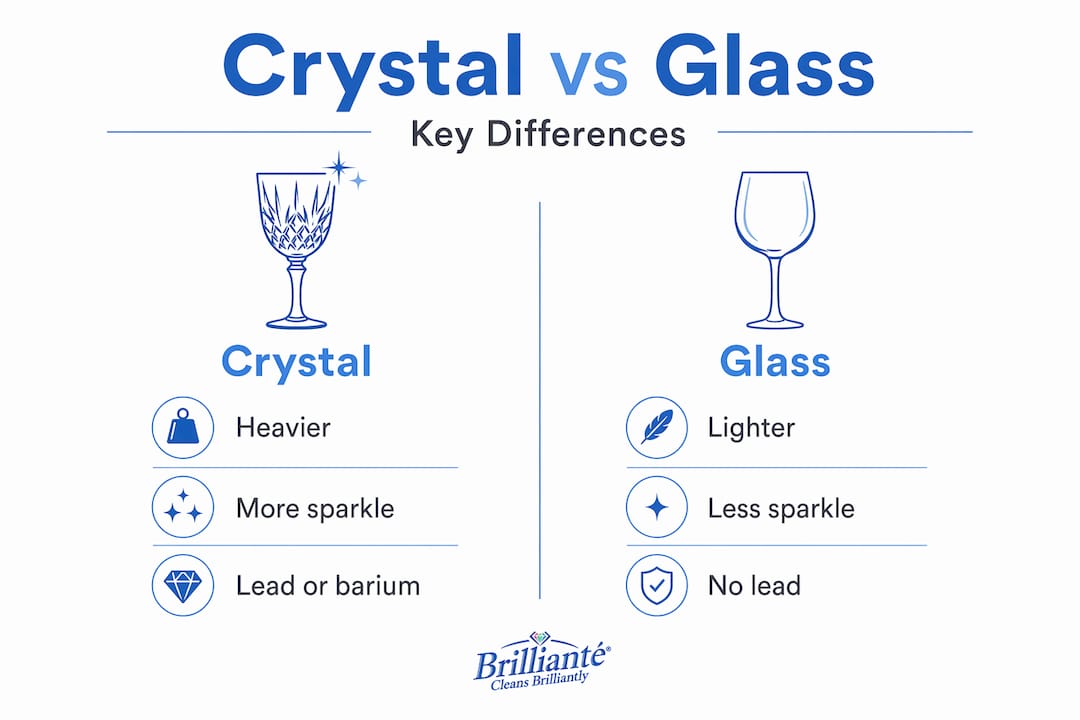
These aren’t just numbers on a chart. The higher density makes crystal noticeably heavier in your hand. The superior refractive index means light bends more dramatically as it passes through, creating that signature sparkle. And the mineral content changes the molecular structure in a way that gives crystal its famous resonant ring when tapped.
Here’s what this means practically for your home décor:
- Crystal chandeliers refract light into dazzling color displays, especially in rooms with natural sunlight
- Glass chandeliers offer clean, simple light diffusion with a more understated look
- Crystal is heavier, which matters for hanging hardware and ceiling mounts
- Crystal requires more careful handling because the same mineral content that creates brilliance also makes it more prone to etching from harsh chemicals
Understanding these key differences and care requirements isn’t just an academic exercise. It directly shapes how you should clean, polish, and maintain your fixture for the long term.
“The brilliance of lead crystal comes from its high refractive index, which bends light at greater angles than ordinary glass, dispersing it into its spectral components — the rainbow effect that makes crystal chandeliers so visually stunning.”
Five reliable ways to tell crystal from glass
With the science in mind, here’s exactly how you can put these differences to the test at home. You don’t need any special equipment for most of these methods — just careful observation and a little patience.
-
Weight test. Pick up the piece and compare it to something similar in size and shape. Crystal feels noticeably heavier than glass of similar dimensions because the mineral additives increase density throughout the material. This is one of the fastest and most intuitive tests you can perform.
-
Sound test (ping test). Lightly tap the rim with your fingernail or a soft object. Crystal produces a long, bell-like ring that sustains for several seconds. Glass gives a short, dull thud or clink with no sustain. Repeat the tap a couple of times on different spots to confirm.
-
Light refraction test. Hold the piece up to direct sunlight or a bright lamp. Crystal shows rainbow prisms and flashes of color as light passes through. Glass transmits light flatly and may even show a slight green tint from iron impurities in the raw material. This test works beautifully on chandelier drops when sunlight comes through a window.
-
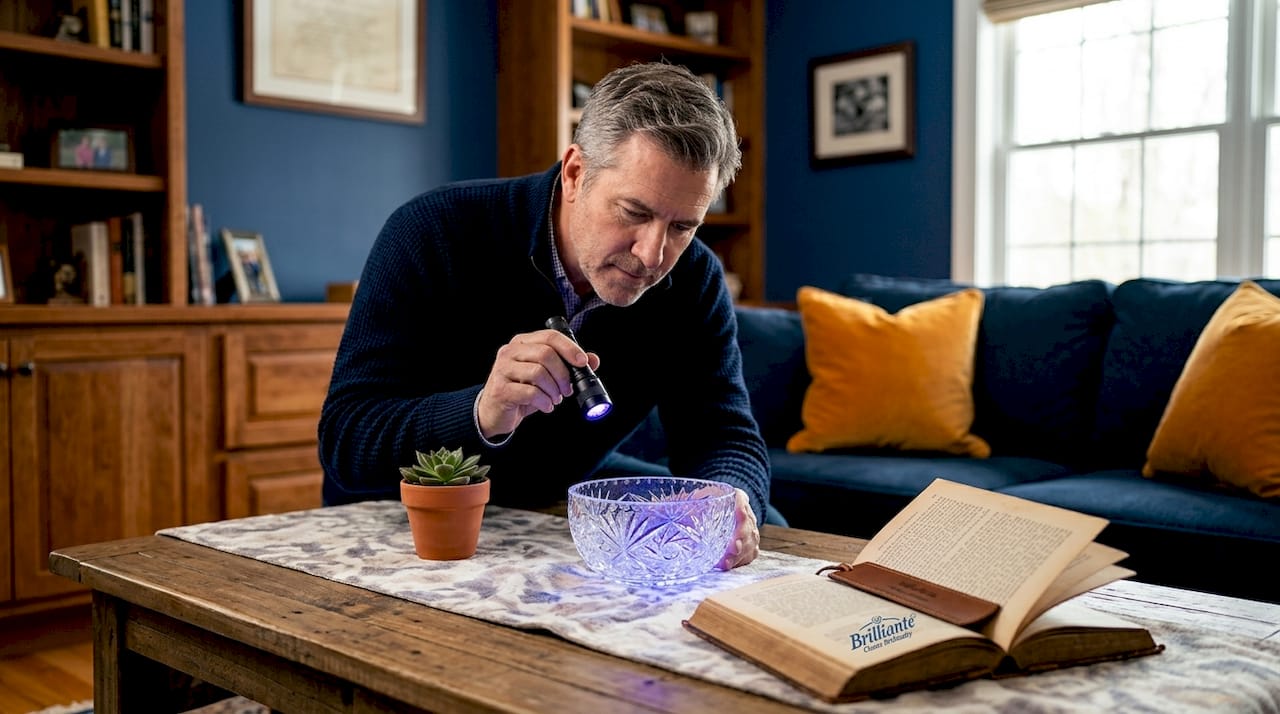
UV blacklight test. In a darkened room, shine a UV blacklight on the piece. Lead crystal often glows blue or purple under UV light due to the lead oxide content. Regular glass does not glow. Important caveat: lead-free crystal formulations typically won’t glow either, so a negative result doesn’t automatically mean it’s glass.
-
Visual clarity test. Look through the piece at a fine-printed page or a straight line. Crystal produces exceptional clarity with minimal distortion, while lower-quality glass may have tiny bubbles, slight waviness, or uneven thickness that causes distortion.
| Test | Crystal result | Glass result | Reliability |
|---|---|---|---|
| Weight | Heavier | Lighter | High |
| Sound (ping) | Bell ring, sustains | Dull clink | High |
| Light refraction | Rainbow prisms | Flat, possible green tint | High |
| UV blacklight | Blue/purple glow (lead) | No glow | Medium (lead-dependent) |
| Visual clarity | Near flawless | May show minor distortion | Medium |
Pro Tip: Never rely on just one test. A thick-walled glass piece might feel heavier than a thin crystal one, and the sound test can vary depending on the shape or thickness of the piece. Use at least two or three tests together for a reliable conclusion. This homeowner’s guide to telling crystal from glass walks through each method in more detail, including visual examples.
A note on chandelier drops specifically: When testing chandelier pieces, be especially gentle with the sound test. You want a light tap, not pressure that could stress a mounting hole or existing micro-crack. Identifying crystal at home on a hanging fixture takes more care than testing a loose bowl or glass on a counter.
Statistic spotlight: Crystal’s refractive index of 1.56 to 1.70 is up to 13% higher than glass, which explains why even a modest chandelier crystal can throw brilliant color patterns across an entire room on a sunny afternoon.
Special cases: Lead-free crystal, K9, and avoiding common mistakes
While most items are straightforward, some high-quality glasses and newer crystals can blur the lines between categories. These edge cases trip up even experienced collectors and interior designers.
Lead-free crystal is the most common source of confusion. Manufacturers replaced lead oxide with barium oxide or zinc oxide to create a safer product, especially for drinkware. Lead-free crystal still mimics lead crystal properties closely — it’s dense, sparkling, and passes most visual tests with flying colors. However, it won’t glow under UV light the way lead crystal does. For chandeliers, lead-free crystal is an excellent choice and becoming more standard in premium fixtures.
K9 glass is a completely different situation. Popular in budget and mid-range chandeliers, K9 is a type of optical glass (not true crystal) that looks impressive but behaves differently. It’s lighter than crystal, less refractive, and won’t produce the same deep ping sound. A K9 chandelier can still look beautiful, but it won’t have the fire and brilliance of genuine crystal. Knowing this helps you set realistic expectations when purchasing and cleaning.
Here are the most common mistakes people make when trying to identify their material:
- Trusting brand labels alone. Marketing terms like “crystalline glass” or “crystal clear” don’t guarantee actual crystal composition.
- Relying only on appearance. Some high-quality glass is cut and polished to look exactly like crystal at first glance.
- Single-test conclusions. Shape and wall thickness both affect the sound test. A particularly thick glass piece might ring more than a thin crystal one.
- Ignoring the base or connector pieces. On chandeliers, the drops might be crystal while the frame is metal or glass — test the decorative pieces specifically.
“There are no fixed empirical benchmarks like exact ring duration, but there is consistent qualitative agreement across all sources on the core properties that distinguish crystal from glass.”
Pro Tip: When in doubt about a chandelier purchase, ask the retailer specifically whether the drops are lead crystal, lead-free crystal, or K9 glass. A reputable seller will know the answer and it affects both the price and the cleaning approach you’ll need to take. Check this chandelier difference guide for a deeper breakdown of what to look for before you buy.
What the difference means for cleaning and care
So, once you’ve identified your piece, here’s how the difference plays out in everyday care and maintenance. This is where proper identification pays off directly.
Crystal chandeliers need more frequent attention — ideally every 2 to 3 months — because their intricate cuts and facets trap dust more aggressively than smooth glass surfaces. Glass chandeliers can typically go 3 to 6 months between cleanings. Both schedules depend on your home environment (kitchens accumulate grease faster, for example), but crystal’s complex geometry means more surface area for airborne particles to settle.
For crystal:
- Always use distilled water. Tap water leaves mineral deposits on cut surfaces that are difficult to remove without risking scratches.
- Wear clean cotton or lint-free gloves. The oils from fingertips leave smudges that show dramatically on highly refractive crystal.
- Use a non-abrasive cleaner specifically formulated for crystal. Harsh chemicals etch the surface over time, permanently reducing sparkle.
- Handle each drop individually when doing a deep clean rather than spraying generously and hoping for the best.
- Avoid long-term storage of acidic liquids in lead crystal vessels due to potential leaching — this applies to decanters, not chandeliers, but it underscores why chemistry matters.
For glass:
- Standard glass cleaner works well for most fixtures.
- Glass is less prone to visible smudging under normal conditions.
- You can be slightly less precious about the cleaning process, though gentle handling still extends the life of the fixture.
- Avoid abrasive scrubbers regardless — no glass benefits from scratching.
Pro Tip: Before you start cleaning any chandelier, turn off the power and allow the bulbs to cool completely. For crystal chandeliers especially, a small spray-and-drip method keeps you from over-handling individual pieces and risking chips or stress fractures. A product that lets you clean and preserve chandeliers without extensive contact is ideal for high-hanging fixtures.
Statistic spotlight: Crystal chandeliers cleaned every 2 to 3 months consistently maintain their refractive brilliance because facets stay free of the fine dust layer that mutes light dispersion between the cuts.
The right cleaning routine also depends on your chandelier’s design. Heavily cut crystal drops need more careful rinsing to avoid soap residue in the grooves. Smooth, molded glass pieces are far more forgiving. This care and cleaning guide covers specific techniques for both material types in a room-by-room context.
The truth about recognizing and caring for crystal: What most guides miss
Here’s something most crystal identification guides won’t tell you: no single test is foolproof in every situation, and obsessing over perfect identification can actually distract from what matters most — consistent, careful maintenance.
We’ve seen homeowners spend hours trying to confirm whether their chandelier is lead crystal or lead-free crystal, then clean it with a harsh all-purpose spray because they felt confident about the identification step. That’s backwards thinking. The identification matters because it informs care. If you’ve correctly identified a piece as crystal (lead or lead-free), the care approach is similar: gentle, non-abrasive, with distilled water and the right cleaner. Getting philosophical about exactly which minerals are present won’t save your chandelier from a scratchy cloth.
Combining multiple tests gives you the most accurate picture because each test addresses a different physical property. Weight speaks to density. Sound speaks to elasticity and molecular structure. Light refraction speaks to the refractive index. No individual property is unique enough to guarantee a definitive answer on its own, but together they build a compelling case.
Another thing most guides ignore: context matters enormously. A chandelier in a dining room that gets regular cooking vapors needs cleaning more often regardless of material. A crystal fixture in a bedroom with filtered air might genuinely look great at four months. Don’t follow a rigid schedule blindly — look at the actual sparkle. If it’s muted, it needs cleaning.
The smartest approach to choosing and caring for chandeliers is this: identify your material with multiple tests, understand its specific needs, then build a realistic maintenance routine you’ll actually follow. A glass chandelier cleaned every two months looks far better than a crystal one that hasn’t been touched in a year.
Keep your crystal and glass pieces brilliant for years to come
You’ve done the work of identifying your material and understanding what it needs. Now the right cleaner makes all the difference in whether that knowledge actually translates into lasting brilliance.
Brilliante Crystal Chandelier Cleaner makes the maintenance step genuinely simple. This specially formulated, drip-dry solution is proudly made in the USA. Just spray it on, let it drip dry, and the chandelier does the rest. No harsh rubbing, no abrasive contact, no residue. It’s non-abrasive, environmentally friendly, and safe for metal fixtures so it won’t tarnish the frame while you’re caring for the crystal. Rated #1 by hundreds of satisfied customers, Brilliante is the smart next step after you’ve correctly identified and understood your chandelier material. Visit brilliantecrystalcleaner.com to explore the full product line and find the right solution for your home.
Frequently asked questions
How do I know if my chandelier drops are crystal or glass?
Try the weight and sound tests — crystal drops are noticeably heavier and produce a bell-like ring when lightly tapped, while glass produces a short, dull clink.
Does real crystal always glow under UV light?
Only lead crystal typically glows blue or purple under blacklight; lead-free crystal often does not, so a negative result alone doesn’t confirm glass.
Is lead-free crystal safe for food and drink?
Yes, lead-free crystal is safe and is the preferred choice for any items that come into direct contact with food or beverages.
How often should I clean a crystal chandelier versus a glass one?
Crystal should be cleaned every 2 to 3 months and glass every 3 to 6 months, always using methods appropriate for each material.
What’s the best single test if I can only use one?
The weight test is the most accessible single method, but using multiple tests together — weight, sound, and light refraction — gives you far more reliable results.