
Transform Your Home with Elegant Interior Lighting & Crystal Care
TL;DR:
- Layered lighting creates depth, warmth, and luxury through ambient, task, and accent sources.
- Regular cleaning and maintenance preserve the brilliance of crystal chandeliers and avoid damage.
- Proper fixture selection, placement, and control enhance room elegance and functionality.
Most homeowners assume that a single bright overhead fixture is enough to make a room feel polished. It isn’t. Layered lighting combines ambient, task, and accent sources to create depth, warmth, and a sense of luxury that one bulb simply cannot deliver. Crystal chandeliers sit at the heart of this strategy, acting as both a light source and a stunning focal point. But even the most breathtaking fixture loses its magic under a layer of dust and grime. This guide walks you through smart lighting strategies and the crystal care routines that keep your home looking its absolute best.
Key Takeaways
| Point | Details |
|---|---|
| Layered lighting matters | Combining ambient, task, and accent lights dramatically boosts home elegance and comfort. |
| Select fixtures wisely | Choose lighting fixtures that complement your décor and suit each room’s functional needs. |
| Crystal care is vital | Regular dusting and gentle deep cleaning preserve the brilliance and value of chandeliers. |
| Avoid common pitfalls | Using the wrong cleaners or techniques can damage luxury lighting—always follow best practices. |
Understanding the fundamentals of home interior lighting
Think of your home’s lighting the way a photographer thinks about a shoot. You don’t just point one bright light at a subject and call it done. You layer sources, adjust angles, and control intensity. The same principle applies to interior design.
The three lighting layers every elegant home needs:
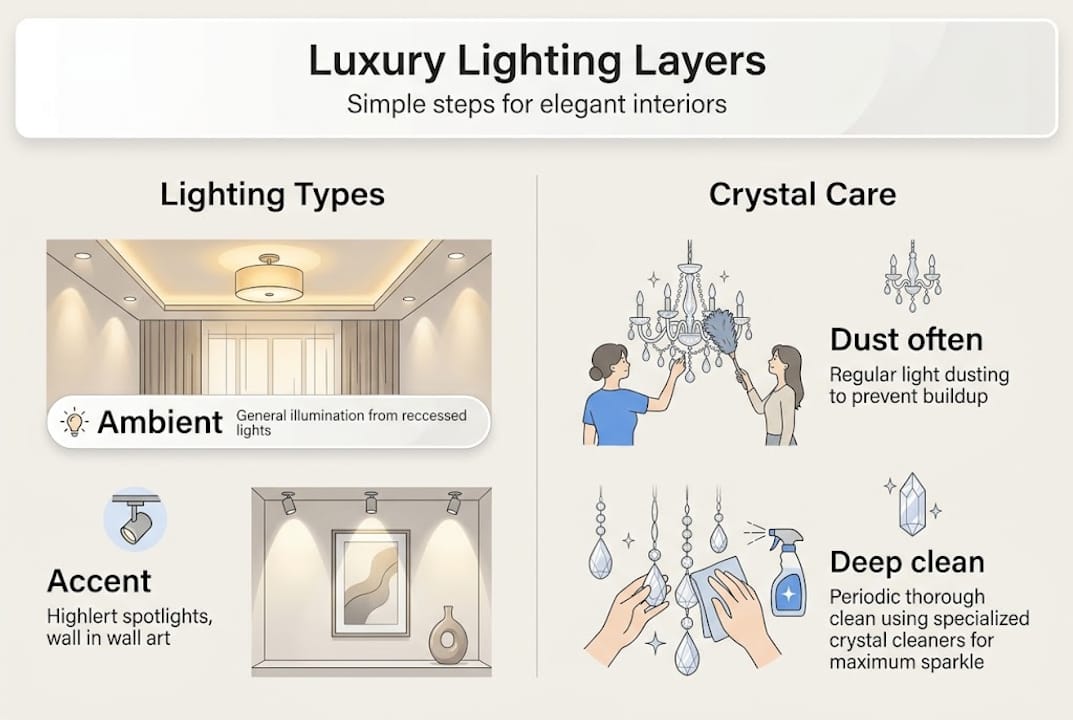
- Ambient lighting is your base layer. It fills the room with general illumination, usually from ceiling fixtures, recessed lights, or chandeliers.
- Task lighting focuses on specific activities. Reading lamps, under-cabinet kitchen lights, and vanity mirrors fall into this category.
- Accent lighting highlights architectural features, artwork, or decorative objects. Think wall sconces, picture lights, and directional spotlights.
Strategic layering meaningfully increases perceived luxury, which means the way you combine these three types matters as much as the fixtures themselves.
Color temperature and CRI: two numbers worth knowing
Color temperature is measured in Kelvins (K). For a warm, inviting glow, optimal luxury lighting sits at 2400K–2700K with a CRI (Color Rendering Index) of 90 or higher. CRI measures how accurately a light source shows the true colors of objects. A CRI of 90+ means your crystal chandelier will sparkle the way it was designed to, and your upholstery, artwork, and finishes will all look their richest.
| Feature | Lower quality lighting | Luxury-level lighting |
|---|---|---|
| Color temperature | 3000K–5000K (cool/harsh) | 2400K–2700K (warm/rich) |
| CRI | Below 80 | 90 or higher |
| Dimmer compatibility | Often none | Essential |
| Effect on space | Flat, clinical | Warm, layered, elegant |
Dimmers and smart controls are not optional extras in a well-designed space. They let you shift the mood from bright and functional during the day to soft and intimate in the evening, all without changing a single bulb.
Pro Tip: Install dimmer switches on every fixture in your main living areas. The ability to dial down your ambient lighting while keeping accent sources active is one of the simplest ways to add instant elegance to any room.
Common lighting mistakes include relying on a single overhead fixture, using daylight-temperature bulbs in living spaces, and ignoring the ceiling height when choosing fixtures. All three flatten a room’s potential.
Choosing the right lighting fixtures for style and function
Fixtures are not just hardware. They are design statements. Choosing the right one for each purpose shapes how a room feels before a single light is even switched on.
Fixture types and their roles:
- Recessed lighting is ideal for ambient layers in kitchens, hallways, and bathrooms. It stays out of the way visually but provides solid, even coverage.
- Wall sconces add accent or task lighting while contributing texture and style to walls.
- Pendant lights work beautifully over kitchen islands or dining tables, combining task and ambient functions with strong visual impact.
- Crystal chandeliers are in a category of their own.
A crystal chandelier serves triple duty. It functions as an ambient light source, acts as a room’s focal point, and works as an accent element by refracting light into glittering patterns across walls and ceilings. No other fixture does all three simultaneously.
| Fixture type | Primary lighting layer | Best room placement | Style impact |
|---|---|---|---|
| Recessed lights | Ambient | Kitchen, hallway, bedroom | Minimal, clean |
| Wall sconces | Accent/task | Living room, bathroom, entryway | Moderate to high |
| Pendant lights | Task/ambient | Kitchen island, dining room | High |
| Crystal chandelier | Ambient/accent | Dining room, foyer, bedroom | Maximum |
Placement and scale matter enormously. A chandelier that’s too small for a dining room ceiling looks lost. One that’s too large overwhelms the space. A useful rule: add the room’s length and width in feet, and that number in inches is roughly the right diameter for a chandelier. For example, a 12 x 14 foot room suits a 26-inch fixture.
Dimmers and smart controls are especially important for chandeliers. Being able to lower a crystal fixture to 30% intensity during dinner creates an entirely different atmosphere than full brightness during cleaning.
Mixing materials, such as pairing a crystal chandelier with matte brass sconces or wood-finish pendants, adds depth without visual chaos. The key is keeping the metal tones consistent across the room.
How to clean and maintain crystal chandeliers for lasting brilliance
A crystal chandelier that hasn’t been cleaned in a year does not look luxurious. It looks neglected. Dust mutes the sparkle, fingerprints cloud the crystals, and grime on the metal frame dulls the entire fixture. Regular cleaning is not just about appearance. It protects your investment.

Before you reach for any cleaning product, follow a proven chandelier cleaning checklist to make sure you’re covering every step safely.
Step-by-step cleaning process:
- Turn off the power and allow the bulbs to cool completely before touching anything.
- Spread a soft blanket or towel on the floor beneath the fixture to catch any drips or dropped pieces.
- Dust the crystals first using a soft, dry microfiber cloth or a feather duster. This removes loose debris before any liquid touches the surface.
- Mix a gentle cleaning solution: either mild dish soap with warm water, or a 4:1 ratio of distilled water to isopropyl alcohol. These are the recommended crystal cleaning methods for safe, effective results.
- Wipe each crystal individually using a soft lint-free cloth or cotton gloves dampened with your solution.
- Clean the metal frame gently using the same damp cloth, taking care not to oversaturate any joints or wiring.
- Allow everything to air dry completely before restoring power.
For a faster option, easy crystal cleaning solutions like a drip-dry spray let you clean without taking the chandelier apart.
Pro Tip: Wear clean cotton gloves throughout the entire process. The oils from your fingertips leave smudges on crystal that are harder to remove than the original dust.
Cleaning schedule to follow: Deep clean every 6 to 12 months, and dust biweekly if the chandelier is in a high-traffic or dusty area. Consistency keeps the job manageable and preserves the crystal’s brilliance long-term.
For more detailed guidance on protecting your fixture during the process, review these safe cleaning techniques before you start.
Mistakes to avoid when caring for luxury lighting
Even well-intentioned homeowners make cleaning mistakes that dull crystal, corrode metal, or permanently damage their fixtures. Knowing what not to do is just as valuable as knowing the right steps.
The most common mistakes and why they matter:
- Using vinegar or ammonia on metal finishes. These acids and bases are effective on some surfaces, but they strip protective coatings from metal frames and can etch antique crystal. Avoid vinegar and ammonia entirely on metal finishes, and be especially cautious with antique pieces.
- Putting crystal in the dishwasher. The heat, harsh detergents, and mechanical agitation can crack crystal or permanently cloud its surface. Hand washing only.
- Spraying cleaner directly onto the fixture while mounted. Excess liquid can drip into the wiring, corrode connections, or collect in joints where it’s impossible to dry properly.
- Skipping gloves. Bare hands transfer fingerprint oils that create new smudges faster than dust settles.
- Not testing your cleaner first. Always apply any new solution to a small, hidden area of crystal or metal before treating the whole fixture. For lead crystal specifically, keep the pH of your solution below 9 to avoid surface damage.
- Wiping too aggressively. Gentle, circular motions with a soft cloth preserve surface integrity. Hard scrubbing scratches crystal and removes metal finishes over time.
Pro Tip: If you’re unsure about a new cleaning product, check the label for ammonia or acidic compounds. Better yet, use a product specifically formulated for crystal chandeliers, like those available through recommended cleaning products designed to be non-abrasive and metal-safe.
One more thing worth remembering: neglect is itself a mistake. Letting dust and grime build up for years creates a cleaning job that’s far more difficult and potentially risky to the fixture. Short, regular maintenance sessions are always easier than a once-a-decade overhaul.
Expert perspective: What most homeowners miss about lighting and chandelier care
Here’s what we see constantly: homeowners invest in a stunning crystal chandelier, hang it in the dining room, and then do nothing else to the lighting in that space. The chandelier becomes an island of sparkle surrounded by flat, uninspired light. And within a year, it’s dull from dust anyway.
The truth is that a modestly priced chandelier in a well-layered, thoughtfully controlled lighting scheme will outperform an expensive fixture in a poorly designed one every single time. Adaptability matters more than price. A room that shifts from bright and energetic to warm and intimate with the touch of a dimmer feels luxurious regardless of what the fixture cost.
The same logic applies to care. Consistent biweekly dusting and an annual deep clean preserve more brilliance than any single restoration attempt. We’ve seen fixtures that were cleaned and maintained regularly for ten years look better than newer ones that were ignored. Lighting and care routines aren’t afterthoughts. They are the strategy.
Bring elegance home with expert cleaning solutions
Everything you’ve learned here points to one clear takeaway: beautiful lighting requires consistent care, and crystal chandeliers deserve products that are genuinely safe and effective.

At Brilliante Crystal Cleaner, we’ve made that easy. Our Drip-Dry formula is proudly made in the USA, environmentally friendly, non-abrasive, and safe on metal finishes. Just spray and let it drip. No scrubbing, no disassembly, no guesswork. Whether you’re looking for a trusted crystal cleaning spray or want to browse our full range of cleaning guides, we have everything you need to keep your chandeliers sparkling with minimal effort.
Frequently asked questions
What are the best bulbs for luxury home interior lighting?
Use bulbs with a 2400K–2700K color temperature and a CRI of 90 or higher for a warm, accurate glow that flatters both your décor and your crystal fixtures.
How often should you deep clean a crystal chandelier?
Deep clean every 6 to 12 months and dust biweekly in high-traffic or dusty rooms to keep the fixture sparkling between full cleanings.
Is it safe to use vinegar or ammonia to clean crystal lighting fixtures?
Avoid vinegar and ammonia on metal finishes and antique crystal, as these can etch surfaces and strip protective coatings. Always test any new cleaner on a small hidden area first.
Why is layered lighting recommended over a single overhead fixture?
Layered lighting blends ambient, task, and accent sources to improve function and atmosphere, and is widely regarded as increasing perceived luxury compared to a single overhead source.