
What is refractive index: crystal sparkle guide 2026
What is refractive index: crystal sparkle guide 2026
Dirt on your crystal chandelier can meaningfully reduce its sparkle, robbing you of the dazzling light show you expect. The science behind that brilliance? Refractive index. This optical property controls exactly how light bends, bounces, and splits into rainbows inside each crystal. Understanding refractive index empowers you to choose better crystals, clean them correctly, and maintain maximum sparkle year after year.
Key takeaways
| Point | Details |
|---|---|
| Refractive index definition | Measures how much light slows and bends when entering crystal from air, creating sparkle. |
| Impact on brilliance | Higher refractive index produces stronger light bending, internal reflections, and color dispersion. |
| Crystal type comparison | Lead crystal (1.7-1.9) sparkles more than Murano glass (1.5-1.6) due to refractive index differences. |
| Cleaning’s critical role | Removing surface dirt restores optimal refraction, meaningfully boosting sparkle visibility. |
| Practical application | Knowing refractive index helps you select crystals wisely and maintain their intended brilliance. |
Understanding refractive index: the science behind crystal sparkle
Refractive index sounds technical, but it’s simple once you break it down. Refractive index quantifies how much light slows and bends when entering a material from air. In chandelier crystals, this ratio typically ranges from 1.5 to 2.1. When light hits your crystal at an angle, it doesn’t travel straight through. Instead, it bends at the surface.
That bending is refraction, and it’s what creates the visual magic. Higher refractive index values mean stronger bending. A crystal with a refractive index of 1.9 bends light much more sharply than one at 1.5. This increased bending sends light bouncing inside the crystal, creating internal reflections that multiply the sparkle you see.
Three key optical processes work together:
- Refraction: Light bends when entering and exiting the crystal surface
- Reflection: Light bounces off internal crystal faces before escaping
- Dispersion: Different wavelengths (colors) bend at slightly different angles, creating rainbow effects
Think of refractive index as the crystal’s “light bending power.” The higher this number, the more dramatically light changes direction inside. This explains why some crystals throw brilliant rainbows while others look flat. Air has a refractive index of 1.0. Most chandelier crystals fall between 1.5 and 1.9, giving them enough bending power to create noticeable sparkle without looking artificial.
How refractive index affects crystal sparkle and brilliance
Refractive index directly controls what you see when light hits your chandelier. Higher values create greater bending, which leads to more internal reflections. Each time light bounces inside the crystal before exiting, it adds another flash of brilliance. This is why lead content raises refractive index, creating those dazzling visual effects you associate with premium crystals.
The magic happens in layers. First, light enters the crystal and bends. Then it hits internal facets and reflects back. Some light exits immediately, while other rays bounce multiple times. Higher refractive index crystals trap light longer, creating more bounces and brighter sparkle. This isn’t just about quantity of light; it’s about quality.

Dispersion adds the color dimension. White light contains all wavelengths. When it enters a high refractive index crystal, blue light bends more sharply than red light. This separation creates the rainbow prisms dancing across your ceiling. Lead crystal excels here because its refractive index maximizes this color splitting effect.
Key sparkle factors controlled by refractive index:
- Flash intensity: More bending creates brighter light bursts
- Color separation: Higher index produces stronger rainbow effects
- Internal reflection: Greater bending traps light longer inside crystals
- Surface brilliance: Sharper refraction creates more defined sparkle points
Pro Tip: Crystal cut matters too. Even high refractive index crystals look dull with poor faceting. The cut determines which angles light hits, while refractive index determines how strongly it bends at those angles. Both work together to create brilliance.
Your chandelier’s sparkle depends on this interplay. A perfectly cut crystal with low refractive index will never match the brilliance of a well cut crystal with high refractive index. This is why material choice matters as much as craftsmanship.
Common misconceptions about refractive index
Many people think refractive index only affects how fast light moves through crystal. Wrong. It governs the entire visual experience, from color dispersion to reflection intensity. The speed difference is just the underlying cause; the bending and bouncing are what you actually see.
Another myth: cutting is everything, refractive index doesn’t matter. In reality, cutting and refractive index work as partners. Imagine trying to create sparkle by cutting glass with a refractive index of 1.1. No matter how perfect your facets, the minimal light bending produces weak results. Conversely, high refractive index crystal with sloppy cuts wastes its optical potential.
Some homeowners believe cleaning only removes visible dirt without changing light behavior. This fundamentally misunderstands optics. Surface films don’t just block light; they distort refraction. When light tries to enter a dirty crystal, it first passes through the grime layer. This creates a secondary refractive interface that scatters light randomly instead of directing it through the crystal’s carefully designed facets.
Key misconceptions corrected:
- Myth: Refractive index only affects light speed inside crystals
- Reality: It controls bending angles, reflection patterns, and color dispersion you see
- Myth: Sparkle depends entirely on cutting quality
- Reality: Both refractive index and cutting precision determine final brilliance
- Myth: Cleaning is cosmetic and doesn’t impact optical performance
- Reality: Removing surface contaminants restores proper refraction and measurably increases sparkle
Understanding these distinctions prevents frustration. You might wonder why your expensive chandelier looks dull despite professional installation. Often the answer is simple: accumulated surface oils have created a low refractive index barrier that prevents light from properly entering the crystal. Clean it properly, and the sparkle returns instantly.
Comparison of refractive index values in popular crystal types
Different crystal materials show distinct refractive index ranges that directly predict their sparkle characteristics. This table shows typical values for common chandelier crystals:
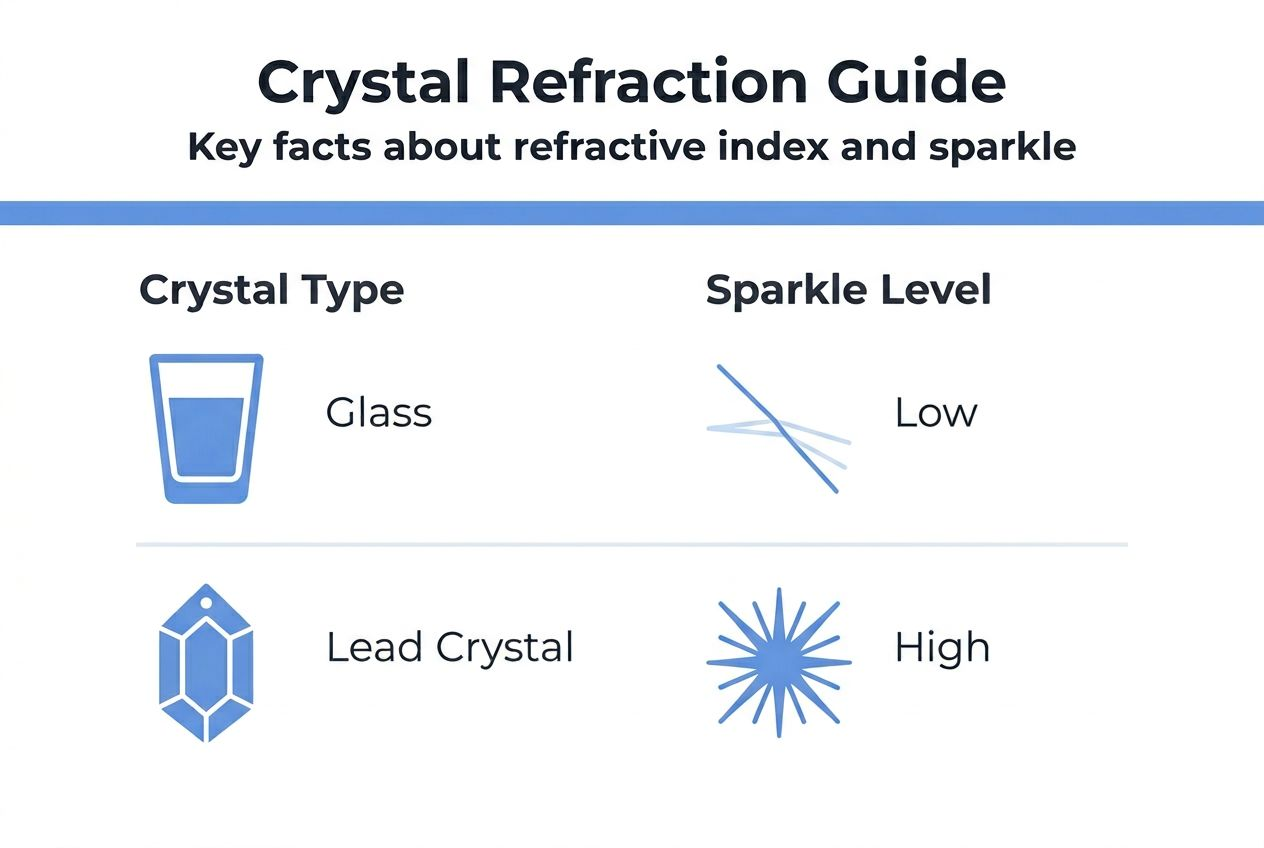
| Crystal Type | Refractive Index Range | Sparkle Characteristics |
|---|---|---|
| Lead Crystal | 1.7-1.9 | Exceptional brilliance, strong rainbow dispersion, premium sparkle |
| Swarovski Crystal | ~1.7 | High precision cutting maximizes balanced brilliance and consistent light effects |
| Murano Glass | 1.5-1.6 | Softer sparkle, classic aesthetic, less dramatic light play |
| Standard Glass | 1.5-1.52 | Minimal sparkle, suitable for ambient lighting but limited brilliance |
Lead crystal dominates the high end because its refractive index creates powerful light bending. The lead oxide content fundamentally changes the glass structure, slowing light more dramatically. This produces the intense sparkle and color separation luxury chandeliers are known for.
Swarovski has built its reputation on consistency. While their refractive index matches quality lead crystal, their machine precision cutting ensures every facet hits optimal angles. This combination of high refractive index material and perfect geometry creates reliable brilliance.
Murano glass represents a different philosophy. Its lower refractive index produces gentler sparkle. This suits traditional aesthetics where subtle elegance matters more than dramatic flash. The tradeoff is reduced brilliance, but some designers prefer this softer look.
Key selection insights:
- Higher refractive index means more dramatic indoor sparkle and brighter light effects
- Lead crystal offers maximum brilliance but requires careful handling
- Swarovski balances high refractive index with consistent manufacturing quality
- Murano glass prioritizes artistic character over maximum optical performance
Your choice depends on desired visual impact. Want a chandelier that commands attention with dazzling light shows? Choose high refractive index lead crystal. Prefer understated elegance? Murano’s lower index creates softer effects. Understanding these differences helps you select crystals that match your vision.
How cleaning impacts refractive quality and appearance
Surface contamination is refractive index’s worst enemy. Dirt and oils reduce light transmission and distort refraction patterns significantly. When dust accumulates, it creates a layer with its own refractive properties, usually much lower than the crystal itself. Light hits this dirty barrier first, scattering randomly before reaching the crystal.
The impact is real and noticeable. Clean crystals transmit far more incident light into their structure where refractive index can work its magic. Dirty crystals lose a meaningful portion of light at the contaminated surface. This isn’t just dimming; it’s disrupted refraction. Instead of bending at precise angles determined by the crystal’s refractive index, light scatters chaotically through the grime.
Oils are particularly problematic. Fingerprints create thin films that act as secondary lenses. These films have low refractive indices around 1.4, far below quality crystal. When light passes through oil before entering crystal, the initial bending happens at the wrong angle. This throws off the entire internal reflection pattern the crystal cut was designed to create.
Specialized crystal cleaners solve this by removing contaminants without residue. Generic cleaners often leave films that create new refractive barriers. The importance of proper chandelier cleaning goes beyond appearance; it directly restores the optical conditions needed for maximum sparkle.
Cleaning benefits for refractive quality:
- Restored light entry: Clean surfaces allow proper refraction at crystal interface
- Eliminated scatter: Removing dirt stops random light dispersion
- Maximum transmission: Clean crystals let significantly more light enter for internal reflection
- Proper dispersion: Clean surfaces enable designed color separation effects
Pro Tip: Clean crystals monthly in high traffic areas. Even invisible oils from airborne cooking particles accumulate and degrade refractive performance. Regular maintenance preserves the brilliance you paid for.
Think of cleaning as refractive index maintenance. The crystal’s inherent optical properties never change, but surface conditions determine whether those properties can function. A crystal with refractive index 1.8 covered in grime performs worse than a crystal with refractive index 1.6 kept spotless. Cleaning isn’t optional; it’s essential for realizing your chandelier’s full potential.
Summary: optimizing crystal chandelier sparkle through refractive index knowledge
Refractive index is the master control for how light behaves in your chandelier. It governs bending angles when light enters crystals, determines internal reflection patterns, and controls color dispersion intensity. Understanding this single number unlocks smarter crystal selection and better care practices.
Higher refractive index always means more sparkle, all else being equal. Lead crystal at 1.7-1.9 outshines standard glass at 1.5 because it bends light more dramatically. This creates stronger internal reflections and more vivid rainbow effects. When shopping for crystals, refractive index predicts visual performance.
Cleaning preserves refractive quality by maintaining clean surfaces for optimal light entry. Surface contaminants act as low refractive index barriers that scatter light wastefully. Removing them restores the precise refraction your crystals were designed to deliver, which can meaningfully increase perceived sparkle.
Key optimization principles:
- Material selection: Choose crystals with refractive index 1.7+ for maximum brilliance
- Regular cleaning: Maintain surface clarity to preserve refractive performance
- Quality cutting: Combine high refractive index with precision faceting for best results
- Proper installation: Position chandeliers where light can showcase refractive effects
- Ongoing care: Monitor sparkle quality as an indicator of cleaning needs
Applying this knowledge transforms chandelier ownership. You’ll recognize when decreased sparkle signals cleaning time rather than crystal degradation. You’ll select replacement crystals based on refractive index data instead of guesswork. Most importantly, you’ll maintain the dazzling light shows that make crystal chandeliers worthwhile investments.
Enhance your chandelier’s sparkle with expert care
Your understanding of refractive index reveals why professional cleaning matters so much. Standard household cleaners leave residues that create unwanted refractive barriers between air and crystal. Specialized solutions restore the clean surfaces needed for light to enter at optimal angles and showcase your chandelier’s true brilliance.
At Brilliante Crystal Cleaner, we’ve formulated products specifically to maximize refractive performance. Our drip dry formula removes contaminants completely without leaving films that distort light entry. This preserves the precise refractive conditions your crystals need for maximum sparkle. Made in the USA with environmentally friendly ingredients, our non-abrasive solution won’t tarnish metal components while restoring optical clarity.
FAQ
What is the refractive index of lead crystal?
Lead crystal typically has a refractive index between 1.7 and 1.9, depending on lead oxide content. This elevated index creates the exceptional sparkle and rainbow dispersion that distinguish premium chandeliers from standard glass alternatives.
How does cleaning affect a chandelier’s sparkle?
Cleaning removes surface dirt and oils that block and distort light before it enters crystals. Proper cleaning can meaningfully increase sparkle visibility by restoring optimal refractive conditions at crystal surfaces. Regular cleaning maintenance preserves the brilliant light effects refractive index creates.
Can different crystal types have the same sparkle?
Crystals with different refractive indices rarely produce identical sparkle because the index directly controls light bending intensity. However, superior cutting precision and spotless cleanliness can help lower index crystals compete with poorly maintained high index alternatives. Both material properties and care quality determine final brilliance.