
How to tell if your chandelier is glass or crystal
TL;DR:
- Most chandeliers look similar under indoor lighting, but optical, weight, and sound tests help distinguish glass from crystal accurately. Combining multiple reliable tests under bright light ensures correct identification, guiding proper cleaning and care to preserve their brilliance. Recognizing the material helps homeowners avoid damage, maintain value, and choose safe maintenance practices for their fixtures.
Even experienced homeowners get this wrong. Under typical indoor lighting, a well-made glass chandelier and a genuine crystal one can look nearly identical — same shimmer, same elegance, same visual appeal. The difference only becomes obvious when you know exactly what to look for and where to look. Correctly identifying your fixture’s material is not just a trivia exercise. It shapes how you clean it, how you handle it, and how much you should invest in its long-term care. The good news: the tests are simple, fast, and require no special equipment.
Key Takeaways
| Point | Details |
|---|---|
| Crystal contains extra minerals | Crystal is a special glass with added minerals like lead oxide that increase weight and sparkle. |
| Use light, weight, and sound tests | Check for rainbows in sunlight, compare the piece’s heft, and listen for a bell-like ring to spot crystal. |
| Combine methods for best results | No single test is foolproof; use a mix for the highest accuracy. |
| Handle with care when testing | Gently tap and avoid strong impacts to prevent chips or cracks, especially with crystal. |
Understanding glass and crystal: What’s the real difference?
Most people assume crystal is an entirely different material from glass. It is not. Crystal is, technically, a form of glass — but one with added minerals that fundamentally change its physical and optical properties. Crystal vs glass differences come down to those mineral additions.
Specifically, crystal contains added minerals such as lead oxide, barium oxide, or zinc oxide. These minerals increase what scientists call the refractive index — the material’s ability to bend and scatter light — which is why crystal produces that famous, brilliant sparkle. Standard glass lacks these additives and bends light far less dramatically.
“Not all crystal contains lead, and not all glass looks dull.” This is the most common misconception homeowners bring to the identification process.
Here is a quick breakdown of key differences:
| Property | Standard glass | Crystal |
|---|---|---|
| Mineral additives | None or minimal | Lead oxide, barium, or zinc |
| Weight | Lighter | Noticeably heavier |
| Light refraction | Softer, minimal sparkle | Strong prismatic effects |
| Sound when tapped | Short, dull clink | Clear, bell-like ring |
| Edge clarity | Can appear slightly greenish | Perfectly clear |
| Cost | Generally lower | Generally higher |
A few myths worth clearing up right away:
- Myth: All crystal sparkles dramatically. Modern lead-free crystal can be more subdued than traditional leaded types.
- Myth: Glass always looks cheap. High-quality art glass can appear beautiful and clear, making identification harder.
- Myth: If it says “crystal” on the packaging, it is. Marketing labels are not always regulated. Some products use “crystal” loosely to describe decorative glass.
- Myth: Crystal will always feel ice-cold. While crystal does tend to hold temperature differently, this test is unreliable in warm rooms.
With the basics set, let’s break down the visual and physical cues you can use at home.
Optical tests: Spotting sparkle, rainbow, and clarity
The single fastest way to get a strong clue about your chandelier’s material is to shine a bright light through one of its drops or panels. Natural sunlight works best, but a phone flashlight held close does the job indoors.
Genuine crystal refracts light into a conspicuous prism or rainbow effect that fans out onto nearby walls and ceilings. Standard non-leaded glass generally does not produce this effect, or produces it so faintly it is barely noticeable. The difference in a well-lit room is striking once you know what you are looking for.
Here is how to perform the optical test step by step:
- Remove one small drop or pendant piece from the chandelier if it is safe and accessible to do so. If not, use a handheld mirror or phone camera to observe the fixture more closely.
- Take the piece near a sunny window during mid-morning or early afternoon when sunlight is direct and strong.
- Hold the piece up and rotate it slowly while pointed toward the light source.
- Observe the light that passes through onto a white wall, sheet of paper, or your hand.
- Crystal will throw sharp, colorful rainbow bands across the surface. Glass will produce a gentler, less colorful glow without defined rainbow bands.
- Try the same test with a phone flashlight in a darkened room for a controlled comparison.
Crystal produces stronger prismatic effects and delivers a cleaner, clearer view through the material itself, while regular glass transmits light in a softer, sometimes slightly greenish or gray-tinted way.
Clarity through the drop matters too. Hold the piece up to text or a patterned surface and look through it. Crystal tends to magnify and sharpen what you see underneath. Glass blurs it slightly or introduces a faint color tint at the edges.
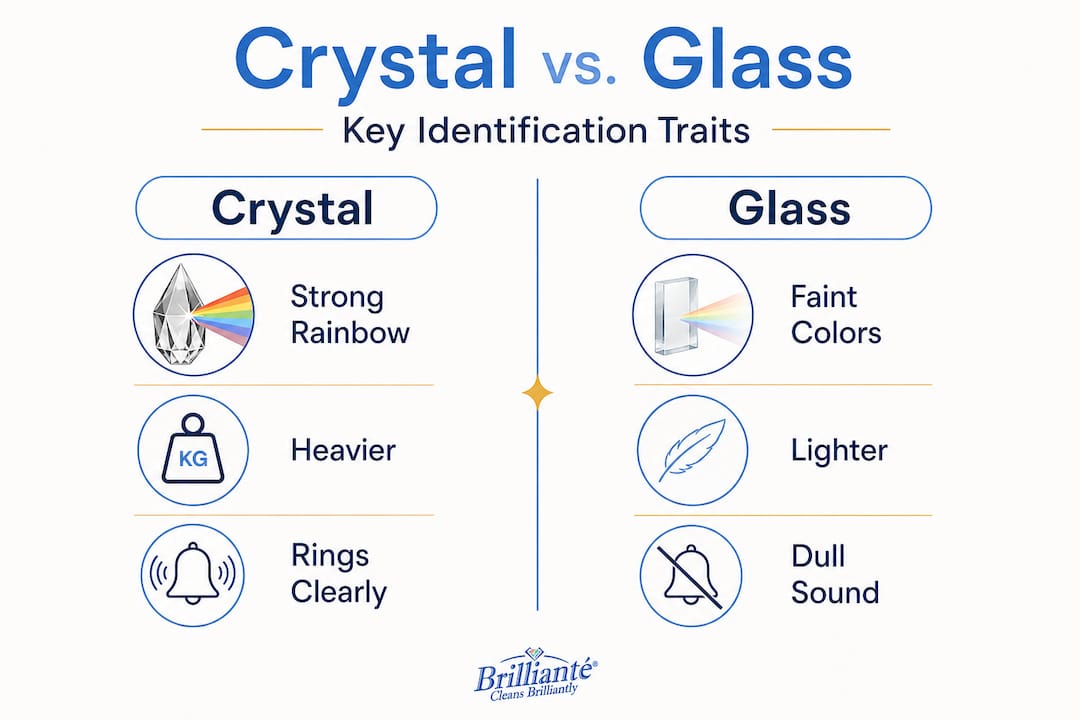
| Test | Crystal result | Glass result |
|---|---|---|
| Sunlight prism | Strong rainbow bands, vivid colors | Faint or no rainbow |
| Flashlight pass-through | Sharp, bright, clear light | Softer, slightly diffuse light |
| Viewing through drop | Magnifies and sharpens | Slight blur or color tint |
| Edge examination | Perfectly clear | May show slight green/gray tint |
Pro Tip: Take a photo of the light pattern your chandelier drop throws onto a white wall. Compare it side by side with photos of known crystal and glass fixtures online. This visual comparison can confirm what your eye detects in real time.
But optical tricks are just one layer — let’s examine the weight and acoustic clues next.
Heft and sound: Two physical tests you can try at home
Optical testing is powerful, but combining it with physical tests makes your identification far more reliable. Two quick physical checks — weight and sound — give you a second and third data point that together paint a clear picture.
Test 1: The weight check
Pick up a drop or pendant piece from your chandelier — again, only if it is safe and accessible. Hold it in your palm and compare it to a similar-sized object you know is standard glass, like a drinking glass or a small glass ornament.
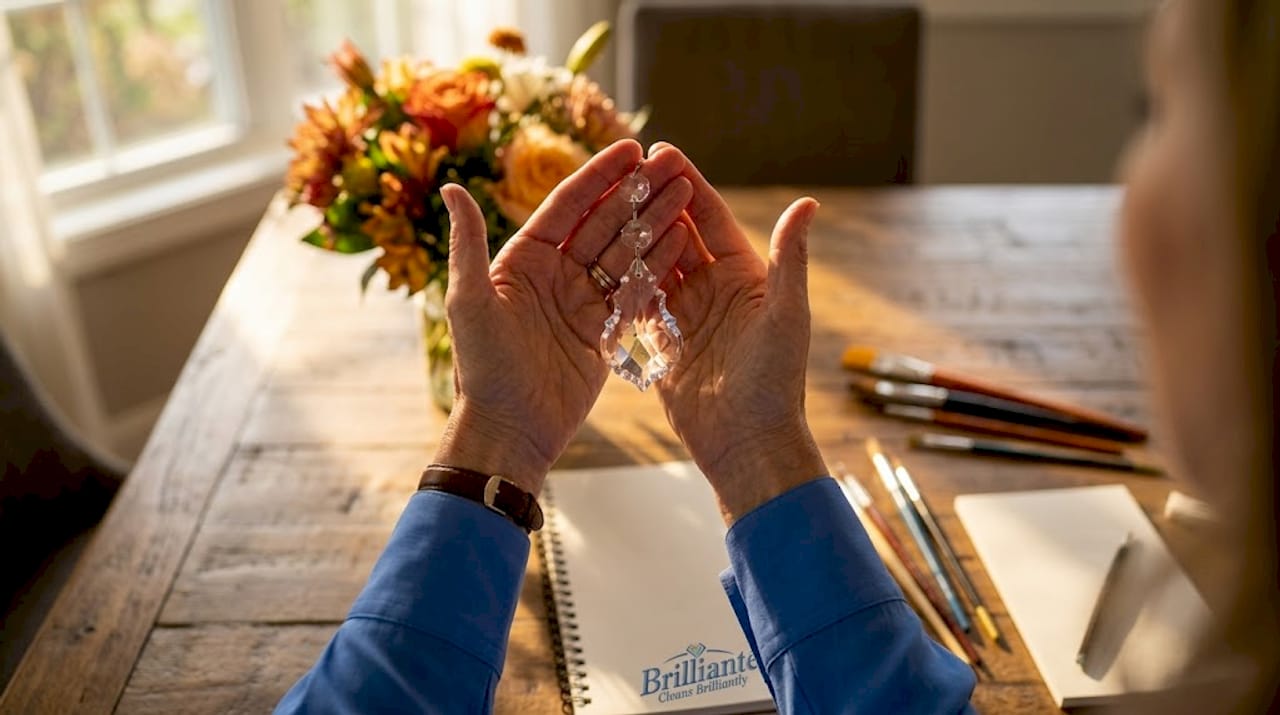
Crystal feels noticeably heavier than regular glass of the same size and shape. This is because the mineral additives — particularly lead oxide in traditional crystal — are denser than plain silica glass. The difference is real and detectable, though it helps to have a reference piece on hand. If you have ever held a high-end wine glass made of crystal next to a standard kitchen glass of the same shape, you have already felt this difference.
Some specific things to notice:
- Crystal drops feel solid and dense in your hand.
- Glass drops feel lighter and sometimes hollow by comparison.
- When you let a crystal piece rest on your fingers, it settles with more presence.
- A single large crystal drop can weigh 30 to 50 percent more than the same size in plain glass.
Test 2: The ring test (acoustic check)
This test is one of the most distinctive and reliable. Hold the drop lightly between two fingers — not gripped firmly — and tap it gently with your fingernail.
Crystal produces a clear, sustained bell-like ring when tapped, similar to the resonance of a fine wine glass. The sound lingers for a second or two after contact. Glass, by contrast, produces a short, dull clink that fades almost immediately. There is no mistaking a genuine crystal ring once you have heard it.
The ring test works best on larger drops since smaller pieces produce fainter sounds. If the piece is too small, listen carefully and conduct the test in a quiet room to catch the subtle difference.
When practicing these tests, always compare against a piece you already know. A crystal wine glass from your cabinet is a perfect reference for both the weight feel and the ring sound.
Pro Tip: Record a short audio clip of the tap on your phone. Crystal’s sustained ring is clearly visible as a longer sound wave in most free audio apps. It is a surprisingly satisfying way to confirm your result and share it with family who may be curious too.
For guidance on safe handling tips when removing drops for testing, always work with the power off and use a soft cloth to protect both your hands and the material.
These clues work best in combination, but what about tricky exceptions and safety?
Edge cases and safety tips: When results are unclear
Not every test gives a clear-cut answer. Modern manufacturing has made the gap between high-quality glass and lead-free crystal much smaller than it was decades ago. Some pieces will leave you genuinely unsure, and that is okay. The key is knowing when to rely on combined results rather than a single test.
Here is a systematic approach for those tricky edge cases:
- Run all three tests before deciding. If you get optical, weight, and sound results that all point the same direction, you can be confident. If one test disagrees with the other two, repeat that test once more under better conditions.
- Account for size. Smaller drops produce fainter rings and feel lighter regardless of composition. Test larger pieces when possible for more definitive results.
- Consider the source. Chandeliers from well-known European makers — particularly from Austria, the Czech Republic, or Italy — are far more likely to be genuine crystal. Fixtures from budget-oriented brands may use glass or low-mineral crystal regardless of labeling.
- Check for markings. Some crystal manufacturers etch or stamp their products. Look for hallmarks on metal fittings or inscriptions on larger decorative pieces.
- Ask the original documentation. If you have purchase receipts, product cards, or installation paperwork from when the chandelier was installed, these often specify the material.
Some lead-free crystal formulas may reduce the intensity of the hallmark optical effects, so single tests can be misleading. Combining multiple checks is the recommended approach — and it is the approach that gives you real confidence.
Safety is worth addressing directly here. Avoid strong impacts or aggressive handling during any test. Crystal, despite being heavier and denser than glass, can still chip if dropped on a hard surface or struck forcefully. Always work over a soft surface like a folded towel. If a drop falls, glass tends to shatter more completely, while crystal often chips rather than shatters — but neither outcome is desirable.
Pro Tip: When you are genuinely unsure whether a piece is glass or crystal, err toward treating it as crystal. Crystal-safe fixture care tips are always gentle enough for glass, but glass-focused cleaning methods can sometimes be too harsh for true crystal. When in doubt, go conservative and choose and care for chandeliers using methods designed for the more delicate material.
Having explored all main testing approaches, let’s clarify what truly matters in practice.
Expert perspective: What most guides miss about crystal vs. glass
Most identification guides list the tests and stop there. What they rarely address is how dramatically room conditions affect your results. We have seen homeowners perform a prism test under warm, yellowish incandescent bulbs and get almost no rainbow from a genuine crystal piece — then test the same drop under direct afternoon sunlight and get vivid, unmistakable color bands. Lighting context matters enormously. Always conduct your optical test under the brightest, most direct light you have access to. Natural sunlight is not a preference; it is a requirement for accurate results.
The second thing most guides underplay is the importance of combining tests. No single test is foolproof. Modern manufacturing tolerances, newer mineral blends, and quality variation within the same chandelier (yes, some fixtures mix glass and crystal components) all create exceptions. The homeowners and enthusiasts who identify their fixtures correctly almost always use at least two tests together. One confirms, the other rules out doubt.
There is also something rarely discussed: the practical implication of knowing your material for long-term care. True crystal is more sensitive to harsh chemicals and rough cleaning tools. It is also more valuable, which means improper care costs you more. Following proper crystal chandelier maintenance practices is not just about cleanliness — it is about protecting something worth protecting. Glass is more forgiving, but it still benefits from appropriate handling. Either way, knowing what you have puts you in control.
Preserve your chandeliers’ brilliance with the right care
Once you have identified your chandelier’s material, the smartest next step is giving it the care it deserves. Cleaning mistakes — using the wrong products or techniques — are far more common after misidentification, and they can dull, streak, or even damage what should be a beautiful, lasting fixture.
Brilliante Crystal Chandelier Cleaner was designed specifically for this moment. Our Drip-Dry formula means you simply spray and walk away — no wiping, no residue, no risk of scratching delicate surfaces. It is non-abrasive, environmentally friendly, and safe on metal fittings too. Whether you have confirmed you have genuine crystal or beautiful decorative glass, Brilliante protects the brilliance you worked to identify. Explore our homeowner’s crystal guide for more tips on caring for your fixture the right way, and discover why hundreds of satisfied homeowners across the USA rate us number one.
Frequently asked questions
Can lead-free crystal still show a strong rainbow effect?
Lead-free crystal may produce some prismatic effect, but it is typically less vivid than traditional leaded crystal. Since lead-free formulas can reduce optical intensity, always combine the prism test with the weight and ring tests for a more reliable result.
Is it safe to tap any chandelier drop for a sound test?
A light tap with your fingernail is generally safe, but avoid applying force. Strong impacts can chip crystal, so always handle drops gently and work over a soft surface like a folded cloth or towel.
What’s the fastest home test for crystal vs. glass?
The sunlight prism test combined with a ring test gives you the fastest and most reliable at-home result. Both tests together take less than two minutes and are highly accurate when performed under direct light.
If I’m still not sure, should I clean my fixture as glass or crystal?
Always default to crystal-safe cleaning practices when in doubt. The best practices for cleaning both materials recommend conservative, non-abrasive methods that protect both glass and crystal without risk.