
Benefits of decluttering: Reduce stress and improve well-being
Living in a cluttered home can raise your cortisol levels by up to 30%, turning everyday stress into a chronic health concern. Most people view clutter as a minor inconvenience, but research reveals it actively undermines mental clarity, emotional balance, and physical health. This guide explores the psychological and practical benefits of decluttering your living space, offering evidence-based methods to transform your home into a sanctuary that supports well-being. You’ll discover how clearing physical space creates mental space, learn proven decluttering frameworks that reduce overwhelm, and gain maintenance strategies that prevent clutter from creeping back into your life.
Key Takeaways
| Point | Details |
|---|---|
| Stress relief through decluttering | Removing visual chaos helps normalize cortisol patterns and supports emotional balance. |
| Lower decision fatigue | Structured decluttering methods give clear choices for each item and reduce mental exhaustion. |
| Consistent maintenance needed | Daily quick resets and long term habits prevent clutter from returning and preserve psychological gains. |
| Values guide letting go | Aligning decisions with personal values makes it easier to part with possessions you no longer need. |
| Improved focus and sleep | A tidy space facilitates better concentration, calmer sleep, stronger relationships, and a more inviting home. |
How decluttering improves your mental and emotional health
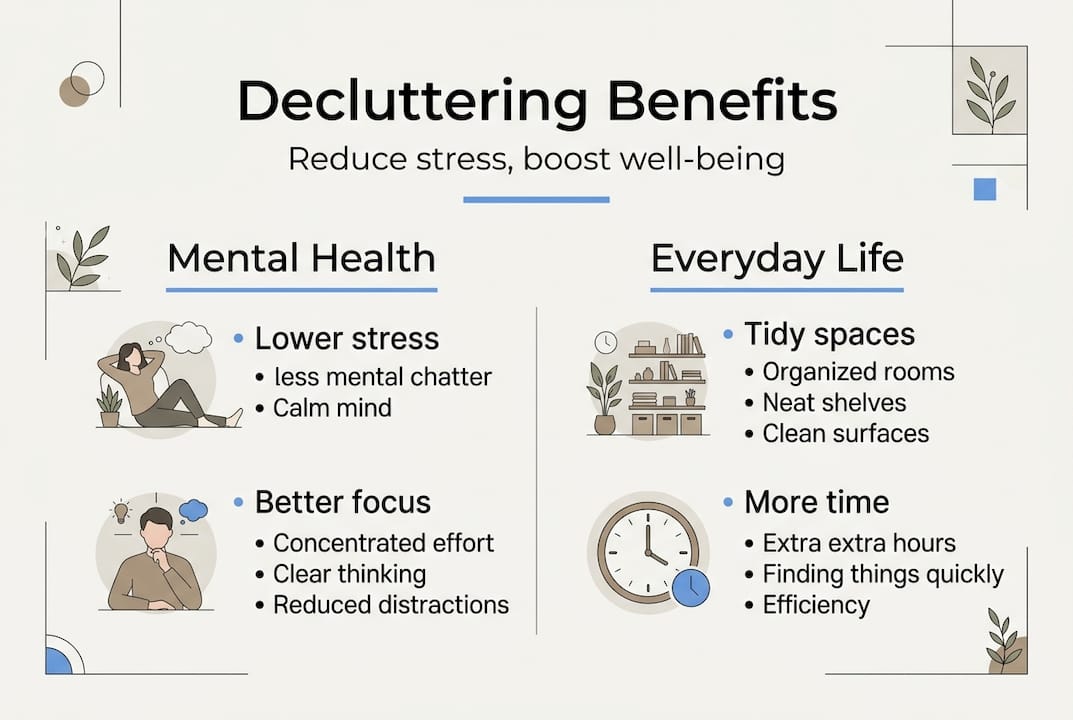
Your physical environment directly influences your psychological state in measurable ways. Studies show that cluttered homes lead to dysregulated cortisol patterns, a stress hormone that, when chronically elevated, contributes to anxiety, depression, and weakened immune function. Women in cluttered homes experience particularly pronounced cortisol spikes throughout the day, creating a persistent low-grade stress response that feels exhausting even when you’re doing nothing particularly demanding.
Clearing your space reverses these patterns. When you remove visual chaos and create organized zones, your brain can finally relax. The constant background processing required to navigate cluttered environments disappears, freeing cognitive resources for creative thinking, problem solving, and genuine relaxation. This shift isn’t just subjective comfort; it’s biochemical relief that your body registers through normalized stress hormones and improved emotional regulation.
The benefits extend beyond stress reduction into comprehensive well-being improvements. Research applying the PERMA model shows decluttering enhances five critical dimensions of flourishing:
- Positive emotion increases as visual harmony replaces chaos, creating spaces that genuinely feel good to inhabit
- Engagement deepens when you can focus without distraction, entering flow states more easily during work or hobbies
- Relationships improve because tidy homes reduce conflict over messes and create welcoming spaces for connection
- Meaning strengthens as your environment reflects your true values rather than accumulated randomness
- Achievement becomes more accessible when you can find what you need and complete tasks without obstacle courses
These improvements compound over time. Better focus leads to higher productivity, which builds confidence and reduces the overwhelm that often triggers emotional eating or other stress responses. Improved sleep quality from serene bedrooms enhances everything from mood regulation to immune function. Stronger relationships provide social support that buffers against life’s inevitable challenges.
“A cluttered room can feel like visual noise that prevents your mind from settling into calm focus. When you clear surfaces and organize belongings, you’re not just tidying objects but creating mental breathing room that supports emotional balance and cognitive performance.”
Maintaining these benefits requires consistent effort. Research on minimalist spaces reveals that visual simplicity directly correlates with reduced anxiety and improved concentration, but these effects fade when clutter returns. Establishing a daily chore list that includes quick resets prevents backsliding and preserves the psychological gains you’ve worked to achieve.
Common decluttering methods and how they help reduce decision fatigue
The biggest obstacle to successful decluttering isn’t laziness or lack of time but decision fatigue. Every item you touch requires a choice: keep, donate, trash, or relocate. When facing thousands of objects, your decision-making capacity depletes rapidly, leading to paralysis, poor choices, or abandoning the project entirely. Structured methods solve this by providing clear frameworks that simplify decisions and maintain momentum.
The 4-Box Method creates immediate clarity by limiting your options to four categories:
- Keep items stay in the room and get organized into designated storage
- Donate items go to charity, friends, or community groups who can use them
- Trash items are broken, expired, or genuinely worthless and get discarded immediately
- Relocate items belong in other rooms and get moved to proper locations
This framework eliminates the agonizing middle ground where you endlessly debate an item’s fate. You simply assess each object once, place it in the appropriate box, and move forward. The physical act of sorting into boxes also creates visible progress, which motivates continued effort even when the task feels overwhelming.
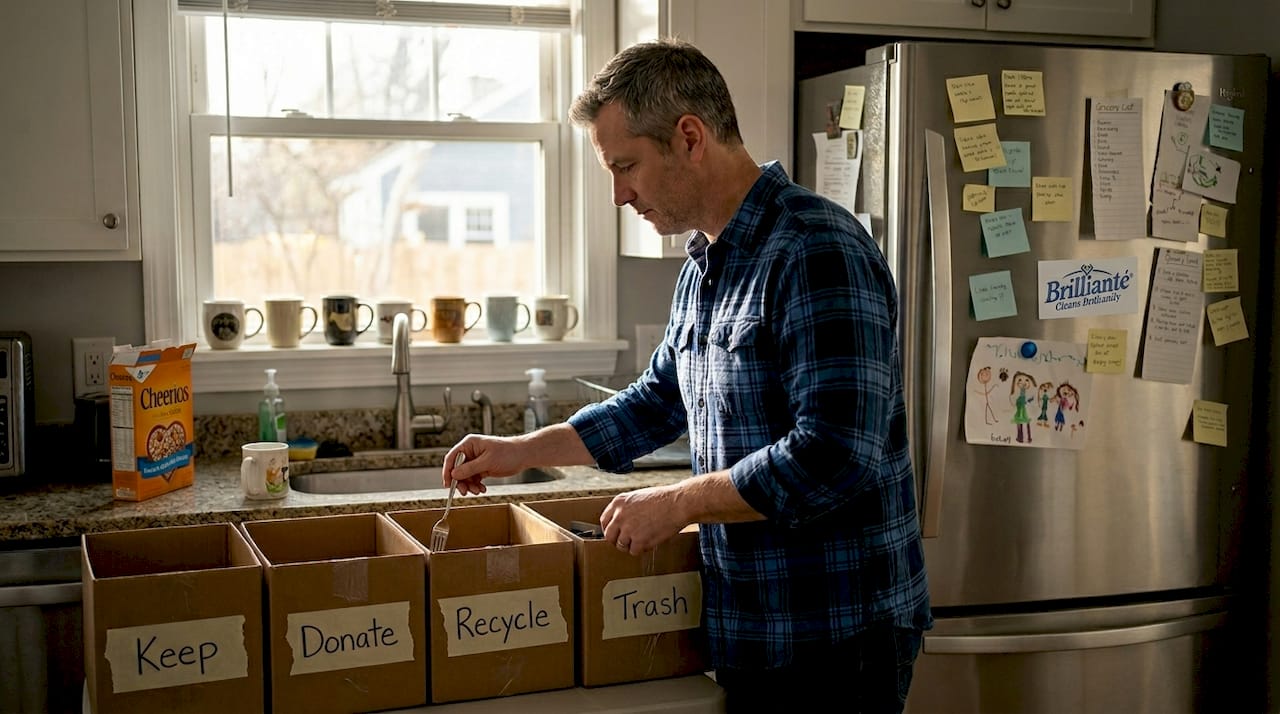
Starting with a room-by-room approach, particularly beginning in the kitchen, provides additional structure. Kitchens contain mostly functional items with clear utility thresholds, making decisions more straightforward than emotionally laden spaces like bedrooms or home offices. You build decluttering momentum and develop decision-making confidence in a relatively easy space before tackling areas where sentimental attachments complicate choices.
The KonMari method offers an alternative framework focused on category rather than location. You gather all items of one type, such as clothing or books, from throughout your home and evaluate each piece by asking whether it sparks joy. This emotional criterion cuts through rational justifications like “I might need this someday” and connects decisions to your authentic feelings about possessions. Working by category also reveals the true extent of what you own, often shocking people into recognizing they have 47 coffee mugs or 12 nearly identical black sweaters.
Pro Tip: Combine methods by using the 4-Box system within a category-based approach. Gather all your books, then sort them into keep, donate, trash, or relocate boxes using the joy criterion. This hybrid captures the emotional clarity of KonMari with the practical momentum of box sorting.
Without systematic approaches, clutter rebounds frighteningly fast. People who declutter without establishing maintenance habits see approximately 80% of clutter return within six months as old patterns reassert themselves. The initial effort feels wasted, creating discouragement that makes future attempts even harder. Choosing a method and sticking with it through completion prevents this cycle by creating new organizational systems that naturally resist clutter accumulation. Consider implementing laundry room organization zones to maintain order in high-traffic areas that typically collect clutter quickly.
The psychological nuance of decluttering: values and challenges for different people
Decluttering isn’t uniformly easy for everyone. Age, mental health conditions, and personality traits significantly influence how stressful the process feels and which strategies work best. Understanding these individual differences helps you approach decluttering with realistic expectations and appropriate support rather than self-criticism when it feels harder than lifestyle magazines suggest.
Older adults face particular challenges due to executive function changes that affect planning, decision-making, and task initiation. What once felt straightforward now requires significantly more mental energy, making decluttering sessions exhausting and overwhelming. Accumulated possessions from decades of life also mean more decisions per square foot than younger people face. These factors combine to make decluttering genuinely more difficult, not a sign of weakness or inability.
People with hoarding tendencies or strong emotional attachments to objects experience similar amplified difficulty. Every item feels weighted with meaning, memory, or potential future utility that makes discarding feel like loss rather than liberation. ADHD, depression, and anxiety disorders further complicate the process by reducing executive function, increasing emotional reactivity to decisions, or creating catastrophic thinking about potential regrets.
Values-based decision making offers a powerful solution to these emotional complexities. Instead of asking “Might I need this someday?” or “Does this have sentimental value?”, you ask “Does keeping this align with my core values?” Research shows that clarifying personal values increases positive affect during decluttering and makes difficult decisions feel more manageable.
Consider these value-aligned questions:
- Family: Does this item support quality time and connection with loved ones, or does managing it steal time from relationships?
- Health: Does this possession contribute to physical or mental well-being, or does it create stress and obstacle courses?
- Altruism: Could donating this item help someone who needs it more than I do, creating greater good than keeping it unused?
- Growth: Does holding onto this support who I’m becoming, or does it anchor me to an outdated version of myself?
This approach transforms decluttering from loss to alignment. You’re not giving up treasured possessions but choosing to live according to what genuinely matters rather than inertia. The values clarification method works particularly well for “just in case” items that you’ve never used but fear discarding. When you recognize that storing unused items contradicts your value of simplicity or steals space from valued activities, the decision becomes clear without feeling like deprivation.
Pro Tip: Start with a single drawer or shelf rather than an entire room. Completing small zones builds confidence and proves you can make these decisions successfully. Success breeds momentum that makes tackling larger areas feel achievable rather than impossible.
Recognizing when professional support might help is also valuable. If decluttering triggers intense anxiety, grief, or paralysis that persists despite trying various approaches, working with a therapist who specializes in hoarding disorder or decision-making challenges can provide crucial support. There’s no shame in needing help; some psychological patterns require professional intervention to shift effectively.
Maintaining decluttered spaces: habits and systems to prevent clutter rebound
The hardest part of decluttering isn’t the initial purge but preventing clutter from returning. Without deliberate maintenance systems, possessions accumulate through daily life like sediment settling in a river. Mail arrives, purchases come home, gifts appear, and suddenly your cleared surfaces disappear under new piles. Research confirms this pattern: 80% of clutter returns within six months when people don’t establish maintenance habits.
Daily resets form the foundation of sustainable organization. Spending just 15 minutes each evening returning items to designated homes prevents the accumulation that leads to overwhelming messes. This brief investment pays exponential dividends by maintaining the psychological benefits of clear spaces and eliminating the need for future marathon decluttering sessions. Think of it like brushing your teeth: a small daily habit that prevents major problems.
Effective maintenance combines several complementary strategies:
- One-touch rule: Put items away immediately upon entering your home rather than setting them down temporarily, which inevitably becomes permanently
- Designated homes: Every possession needs a specific storage location so you always know where it belongs and can return it quickly
- Inbox systems: Create a single landing zone for incoming mail, packages, and miscellaneous items, then process it weekly rather than scattering these items throughout your home
- Regular purges: Schedule quarterly reviews of closets, drawers, and storage areas to remove items that no longer serve you before they accumulate into clutter
| Maintenance Method | Time Investment | Primary Benefit | Best For |
|---|---|---|---|
| Daily 15-minute reset | 15 min/day | Prevents accumulation | Everyone |
| Weekly inbox processing | 30 min/week | Manages incoming items | Paper and package clutter |
| Monthly category review | 1 hour/month | Catches early buildup | Specific trouble zones |
| Quarterly deep assessment | 3 hours/quarter | Removes accumulated excess | Whole home maintenance |
| Annual full audit | 8 hours/year | Comprehensive refresh | Major life transitions |
The key is matching maintenance intensity to your lifestyle and clutter tendencies. If you’re naturally organized, lighter touch systems work fine. If you struggle with clutter accumulation, more frequent and structured maintenance prevents backsliding. Honest self-assessment about your habits helps you choose realistic systems you’ll actually maintain rather than aspirational ones that sound good but never happen.
Integrating maintenance into existing routines increases success rates dramatically. Attach the 15-minute reset to an established habit like after-dinner cleanup or bedtime preparation. Link inbox processing to a specific day like Sunday evenings. These connections leverage habit formation psychology to make maintenance automatic rather than requiring constant willpower.
A comprehensive daily chore list helps structure these maintenance activities alongside regular cleaning tasks, creating a holistic home care routine. Similarly, applying organizational zone principles throughout your home establishes clear systems that naturally resist clutter accumulation by giving everything a logical place.
The psychological benefits of maintenance extend beyond preventing clutter return. Consistent small actions build self-efficacy and a sense of control over your environment. You prove to yourself repeatedly that you can maintain order, which strengthens the identity shift from “cluttered person” to “organized person.” This identity change makes maintenance feel less like discipline and more like natural expression of who you are.
Enjoy a clutter-free home with professional cleaning support
Maintaining a decluttered, serene home becomes even easier when you combine your organizational efforts with professional cleaning support. While decluttering creates the foundation of an orderly space, keeping surfaces pristine and details sparkling requires consistent attention that busy lives don’t always allow. Professional services handle the deep cleaning tasks that preserve your home’s beauty between your maintenance routines.
Consider how much easier maintaining clear counters becomes when you’re not also scrubbing them weekly. Professional cleaners tackle the time-consuming work of detailed cleaning, letting you focus energy on the organizational systems that prevent clutter return. This partnership between your decluttering habits and expert cleaning creates homes that feel both organized and luxuriously maintained.

Discover how professional home cleaning services complement your decluttering journey, providing the support that transforms good intentions into lasting results. From crystal chandeliers to everyday surfaces, expert care preserves the serene environment you’ve worked to create.
FAQ
What are the main psychological benefits of decluttering?
Decluttering reduces cortisol levels by approximately 30%, directly lowering stress and anxiety while improving mood regulation. It also enhances positive emotions, deepens engagement in activities, strengthens relationships, increases sense of meaning, and boosts feelings of accomplishment according to well-being research. These benefits compound over time as your environment consistently supports rather than undermines mental health.
How often should I maintain my decluttered space to prevent clutter from returning?
Daily 15-minute resets are the gold standard for preventing clutter rebound, with research showing this frequency keeps 80% of clutter from returning within six months. Weekly inbox processing and monthly category reviews provide additional support. The specific frequency depends on your lifestyle and natural tendencies, but some form of daily maintenance proves essential for long-term success.
What decluttering method is best for beginners?
The 4-Box Method combined with a room-by-room approach starting in the kitchen works best for beginners. This system provides clear decision categories that eliminate overwhelm while building momentum in a relatively straightforward space. Once you develop confidence with functional items, you can tackle more emotionally complex areas using the same framework or transition to category-based methods like KonMari.
How can personal values help when letting go of sentimental items?
Focusing on core values like family, health, or altruism reframes difficult decisions from loss to alignment with what truly matters. Instead of asking whether an item has sentimental value, you ask whether keeping it supports your values or contradicts them by stealing space and energy. Research shows this values-based approach increases positive emotions during decluttering and makes releasing items feel purposeful rather than painful.