
Efficient lighting for crystal chandeliers: your guide
TL;DR:
- Switching to LED bulbs saves homeowners approximately $225 annually by consuming up to 90% less energy than incandescent lights. Modern LEDs produce rich, warm light, run cool to protect delicate chandelier components, and last up to 25 times longer, enhancing both aesthetics and efficiency. Proper selection, maintenance, and integration of smart controls can significantly extend fixture lifespan while maintaining stunning illumination.
Crystal chandeliers look impossibly glamorous until you realize the bulbs running them are quietly draining your wallet. Most homeowners assume switching to efficient lighting means sacrificing the warm, sparkling glow that makes a chandelier worth having in the first place. That assumption is wrong, and it’s costing you money. Switching to LEDs saves the average household about $225 per year, using up to 90% less energy than incandescent bulbs. This guide shows you how to upgrade your chandelier’s lighting intelligently, maintain its crystals properly, and get the most out of every bulb you install.
Understanding energy-efficient lighting for crystal chandeliers
When most people picture energy-saving lights, they picture the cold, flat glow of a utility room. That’s not what modern LED technology delivers. Today’s LED bulbs produce rich, warm light specifically engineered for decorative fixtures, and they do it without the heat that slowly degrades the metal frames and crystal hangings on your chandelier.
LEDs use up to 90% less energy and last up to 25 times longer than incandescent bulbs, converting electricity directly to light with almost no wasted heat. That thermal difference matters more for chandeliers than for almost any other fixture in your home. Traditional incandescent bulbs radiate heat outward, which over time can loosen the glue or metal pins holding crystal drops in place and cause micro-cracks in the glass. LEDs run cool enough to touch after an hour of use.
The LED lighting benefits most relevant to chandelier owners come down to three things:
- Low heat output: Protects delicate crystal, glue bonds, and metal hardware.
- Long lifespan: Reduces how often you climb a ladder or hire help to swap bulbs.
- Color quality: Modern LEDs offer high color rendering index (CRI) scores of 90 or above, meaning crystals sparkle with accurate, vivid light rather than looking washed out.
The CRI number is one most homeowners skip over, and it’s a mistake. A CRI of 80 is standard. A CRI of 90 or above is what makes crystal prisms throw rainbows across your ceiling instead of pale gray shadows. When you’re shopping, look for that number on the packaging.
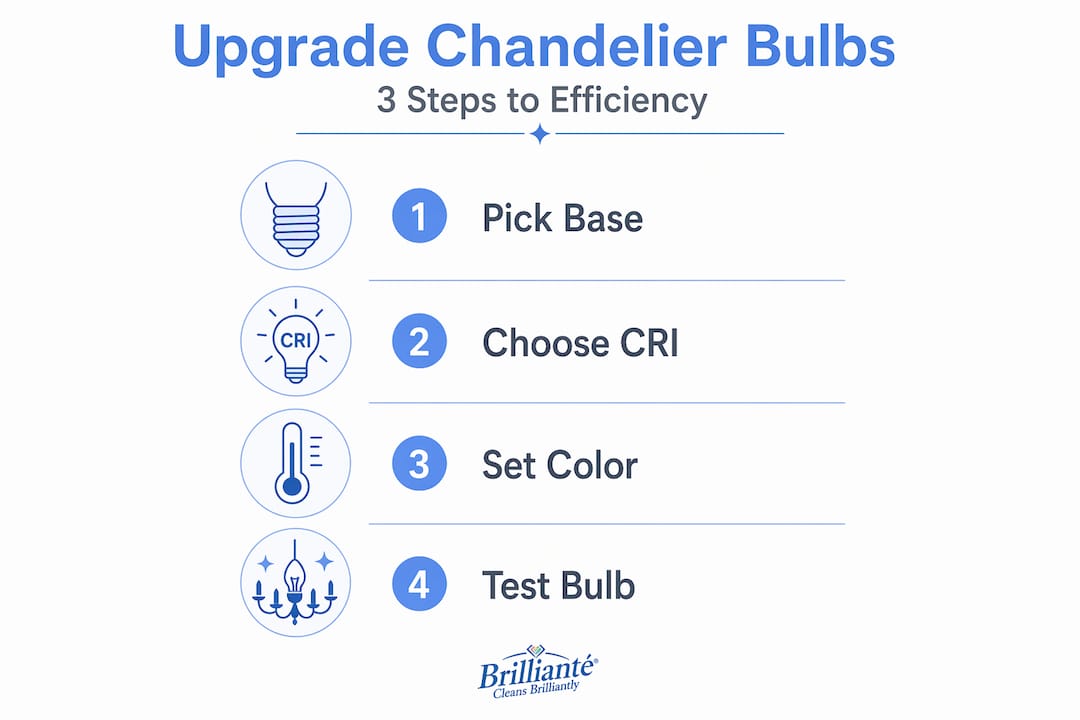
Pro Tip: For a chandelier in a dining room or entryway, choose LEDs rated between 2700K and 3000K color temperature. This produces the warm, golden light that flatters people and makes crystal look expensive rather than clinical.
Choosing the right LED bulbs for your chandelier: a detailed comparison
Selecting the wrong bulb for a chandelier is an easy mistake, and it’s more common than you’d think. Chandeliers typically use candelabra base bulbs (E12 in the US), not the standard medium base (E26) found in most lamps. Using the wrong base physically won’t fit, but buying the wrong wattage equivalent or lumen output is a subtler error that affects both appearance and safety.
ENERGY STAR-qualified LED bulbs save up to $26 in lifetime cost per bulb and last 10,000 or more hours, which is especially valuable for chandeliers where bulb replacement is genuinely inconvenient and sometimes requires a professional.
Here’s how common chandelier bulb options compare:
| Bulb type | Wattage | Lumen output | Lifespan | Estimated cost per bulb |
|---|---|---|---|---|
| Incandescent candelabra | 40W | 400 lm | 1,000 hrs | $1.00 |
| Halogen candelabra | 28W | 370 lm | 2,000 hrs | $2.50 |
| LED candelabra (standard) | 4–5W | 400 lm | 15,000 hrs | $4.00 |
| LED candelabra (ENERGY STAR) | 4–5W | 400 lm | 15,000+ hrs | $6.00 |
| Smart LED candelabra | 4–5W | 400 lm | 15,000+ hrs | $10.00 |
Follow these steps when choosing LED bulbs for your fixture:
- Check the base size. Remove one existing bulb and look for the E12 or E26 marking stamped on the base.
- Match the wattage limit. Your chandelier’s socket has a maximum wattage rating printed inside. Never exceed it, even with LEDs.
- Buy all bulbs from the same batch. Different manufacturing runs can produce slight color temperature variations. A chandelier with mismatched bulbs is instantly noticeable.
- Test one bulb with your dimmer before buying a full set. Not all LED bulbs work smoothly with all dimmers. A bad pairing causes flickering, buzzing, or bulbs that won’t dim below 50%.
- Stock a few spares. When one bulb burns out in a matched set, you need an exact replacement. Discontinued batches can leave you hunting for months.
Pro Tip: If your chandelier has a dimmer and you’re upgrading to LEDs, also replace the dimmer switch itself with a model specifically rated for LED loads. This single step eliminates most flickering and buzzing complaints people have about LED chandeliers.
Effective cleaning and maintenance tips to enhance your chandelier’s glow and efficiency
A dusty chandelier loses significant light output. Dust and film on crystal surfaces scatter and absorb light rather than reflecting it, which means your LEDs are working harder for a dimmer result. Regular care protects your investment and prevents avoidable repairs, and replacing inefficient bulbs while updating controls cuts costs significantly.
Follow this maintenance routine to keep your fixture performing at its best:
- Turn off the power and let bulbs cool. Even LEDs should cool for a few minutes before handling.
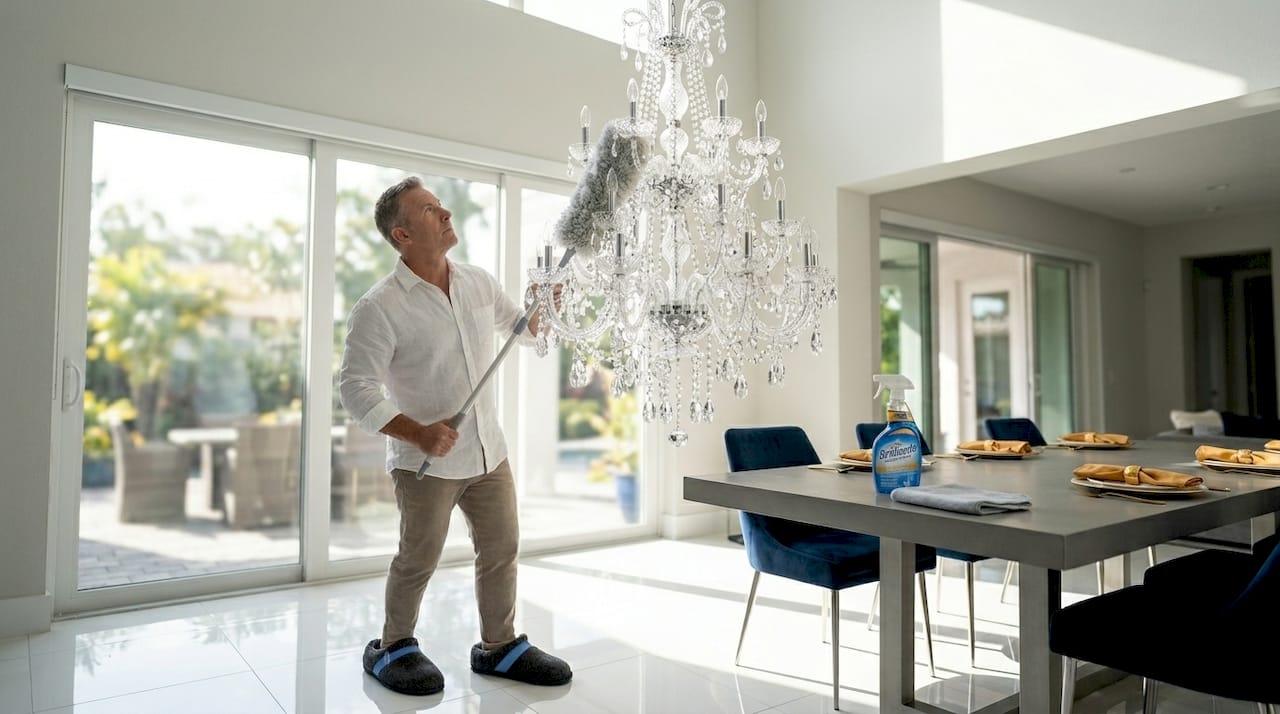
- Dust crystal surfaces with a dry microfiber cloth. Microfiber lifts particles without scratching. Never use paper towels on crystal.
- Spray with a no-rinse crystal cleaner. A drip-dry formula like Brilliante Crystal Cleaner requires no wiping. You spray, and the solution carries dust and grime down with it as it drips off.
- Wipe sockets and hardware with a dry cloth. Check for any green corrosion on brass or copper components while you’re up there. Early corrosion is easy to remove. Ignored corrosion ruins sockets.
- Inspect every crystal attachment point. Look for loose pins, bent wire loops, or chips. Addressing small issues now costs nothing. Waiting until crystals fall costs much more.
- Log the date, cleaning products used, and any observations. A simple note on your phone works fine. This log tells you when cleaning is overdue and helps you track when individual bulbs are approaching end of life.
Pro Tip: Schedule a full cleaning twice a year, but do a quick dust pass every 60 days. Chandeliers in kitchens or near fireplaces accumulate grease and smoke residue faster than those in bedrooms or entryways, so adjust your schedule accordingly.
Integrating smart lighting controls and future-proofing your fixture
Smart lighting technology has moved well past novelty. For chandelier owners, smart controls offer practical energy savings without requiring you to touch a wall switch. Smart bulbs and drivers reduce energy use and extend bulb life through scheduling and adaptive brightness, but you should verify dimmer compatibility before purchase to avoid flicker issues.
Here are the control types worth considering for chandeliers:
- Standard LED dimmers: The most affordable upgrade. Replace your existing switch with an LED-rated dimmer to immediately gain better ambiance and measurable energy reduction at lower brightness settings.
- Smart switches: Control your chandelier from your phone, set schedules, and integrate with voice assistants. The chandelier itself uses standard LED bulbs, so you’re not locked into proprietary hardware.
- Smart bulbs: Each bulb connects to your home Wi-Fi individually. More flexible but more expensive per bulb, and chandelier socket wiring varies, so check compatibility first.
- Timers: The simplest option and underrated. A timer ensures the chandelier isn’t running for hours after everyone’s gone to bed.
| Control type | Energy savings | Install difficulty | Dimming support | Cost range |
|---|---|---|---|---|
| LED dimmer switch | Moderate | Easy | Yes | $15–$40 |
| Smart switch | High | Easy to medium | Yes (most models) | $30–$80 |
| Smart bulbs | High | Easy | Yes | $8–$15 per bulb |
| Mechanical timer | Low to moderate | Easy | No | $10–$25 |
One forward-thinking decision most homeowners skip: choose chandeliers with replaceable bulb sockets rather than integrated LED modules. Integrated modules look sleek but cannot be upgraded or repaired when the LEDs eventually dim. Standard sockets let you swap in whatever the best bulb technology looks like in five years.
Pro Tip: When setting up smart schedules, program the chandelier to dim to 40% during evening hours rather than switching fully off. This maintains ambiance, saves more energy than full brightness, and extends LED lifespan by reducing thermal cycling.
Balancing aesthetics and efficiency: managing light quality in crystal chandeliers
Efficiency means nothing if the chandelier looks wrong. Experts prioritize dimmable LEDs with good color rendering over maximum efficiency for chandeliers, because aesthetic appeal is the entire point of the fixture. The goal isn’t the most efficient bulb. It’s the most efficient bulb that still makes your room feel extraordinary.
Here’s what to focus on for lighting quality that serves both beauty and efficiency:
- CRI 90 or above: This is non-negotiable for crystal chandeliers. Lower CRI light makes crystals look dull and reduces the rainbow refraction effect.
- 2700K for warm, intimate spaces: Dining rooms, bedrooms, and living rooms benefit from this temperature. It flatters skin tones and creates the candlelight warmth traditional chandeliers were designed to mimic.
- 3000K for entryways and showpiece rooms: Slightly cooler, more defined, and excellent for rooms where you want visual drama rather than coziness.
- Full dimming range: Look for LEDs that dim smoothly from 100% down to 5% or lower. Many budget LED bulbs stutter or cut out at low dim levels, which kills the ambiance effect entirely.
- Avoid “cool white” (4000K and above) in residential settings: This color temperature drains warmth from crystal and makes your room feel like a hotel lobby rather than a home.
Overly bright chandeliers also work against crystal. At full blast, a high-lumen fixture flattens the sparkle effect. Dimming to 60% or 70% allows individual crystals to catch and separate the light, producing the prismatic brilliance that makes these fixtures worth owning.
Why many chandelier owners overlook efficient lighting upgrades and what we’ve learned
Most of the hesitation we hear from chandelier owners follows a predictable pattern. They’re worried about ruining something expensive. They assume the process is complicated. Or they bought the chandelier for its look and don’t want to risk changing that look with the “wrong” bulb.
These concerns are valid, but they’re based on the LED technology of ten years ago. Today’s options are genuinely good. For chandelier LED upgrades, matching the exact base type and wattage limit, and testing dimmer compatibility first, eliminates the vast majority of problems. The fix for “I don’t want to ruin the look” is simply choosing a high-CRI bulb at the right color temperature. That’s two numbers to check on a package.
What we’ve found after working with chandelier owners across every price point and style is that the hesitation costs more than the upgrade. Running 12 incandescent candelabra bulbs in a medium-sized chandelier for four hours a day costs roughly $75 per year more than running equivalent LEDs. Over the 15,000-hour lifespan of those LED bulbs, you’re looking at several hundred dollars in pure savings, before you factor in the avoided cost of replacing incandescent bulbs every year.
The other lesson worth sharing: lighting upgrades extend fixture life. Chandeliers with incandescent bulbs accumulate heat damage silently. Crystals loosen, metal tarnishes faster at elevated temperatures, and electrical components degrade sooner. Switching to energy-efficient lighting isn’t just about your electric bill. It’s about getting more years out of a fixture you paid good money for.
Plan one afternoon to do the bulb assessment, buy a test bulb before committing to a full set, and schedule a cleaning while you’re at it. That’s genuinely all it takes.
Enhance your crystal chandelier’s beauty and efficiency with Brilliante Crystal Cleaner
Clean crystals and efficient bulbs work together. A beautifully chosen LED bulb still underperforms if the crystal it’s supposed to illuminate is coated in dust, cooking residue, or fingerprints. That’s exactly the problem Brilliante Crystal Chandelier Cleaner was built to solve.

Brilliante Crystal Cleaner is a proudly USA-made, drip-dry formula that requires no wiping, no disassembly, and no harsh chemicals. Just spray and let it drip. It’s non-abrasive, environmentally friendly, and safe on metal components, so it won’t tarnish the hardware that holds your fixture together. Rated #1 by hundreds of satisfied customers, it takes the hardest part of chandelier ownership off your plate entirely. Pair it with your LED upgrade and you’ll see the difference immediately: brilliant refraction, consistent sparkle, and a fixture that looks professionally maintained without the professional price tag.
Frequently asked questions
How much can I save by switching my chandelier bulbs to LEDs?
Switching to LED bulbs can save approximately $225 per year since LEDs use up to 90% less energy than incandescent bulbs, and they last dramatically longer, reducing replacement costs too.
Are LED bulbs safe to use with delicate crystal chandeliers?
Yes. LEDs convert electricity to light with minimal heat output, which reduces thermal stress on crystal, glue bonds, and metal hardware that traditional incandescent bulbs would slowly degrade over time.
What should I consider when buying LED bulbs for chandeliers?
Match the base type (usually E12 candelabra), respect the socket’s wattage limit, choose a CRI of 90 or above, and test dimmer compatibility with a single bulb before buying a full matched set.
Can smart lighting controls improve chandelier efficiency?
Yes. Smart controls reduce energy use and extend bulb life by scheduling on/off times and adjusting brightness automatically, which is especially useful for chandeliers that tend to run longer than necessary.