
Crystal vs glass: How to clean and preserve chandeliers
TL;DR:
- Crystal contains lead oxide and produces a prismatic rainbow effect, while glass lacks these features.
- Using vinegar on crystal can cause permanent etching and damage its brilliance.
- Proper cleaning involves different methods and frequencies tailored to crystal and glass chandeliers.
Most homeowners assume crystal and glass chandeliers can be cleaned the same way. That assumption is costing people their sparkle. Use the wrong solution on crystal and you risk permanent clouding. Apply a crystal-specific approach to glass and you may waste time and money on unnecessary steps. The material your chandelier is made from changes everything: the products you use, how often you clean, and the techniques that actually work. This guide breaks down the real differences between crystal and glass, explains why those differences matter for cleaning, and gives you a practical plan to keep your fixture dazzling year after year.
Key Takeaways
| Point | Details |
|---|---|
| Know your material | Crystal and glass chandeliers look similar but need different cleaning methods for shine and safety. |
| Avoid harsh cleaners | Vinegar may clean glass but can damage crystal over time, so use material-appropriate products. |
| Clean regularly | Dust chandeliers every few months and schedule deep cleans based on your home’s conditions. |
| Stay organized | Using photos and a tray during disassembly prevents costly mistakes and lost parts. |
Crystal vs glass: What’s the real difference?
At first glance, crystal and glass look nearly identical hanging from your ceiling. But touch them, tap them, or hold them up to the light and the differences become obvious.
Material composition is where it starts. Traditional crystal contains lead oxide, which increases density and refractive index. Refractive index simply means how strongly a material bends light. The higher the index, the more brilliant the sparkle. Modern “crystal” often replaces lead with barium or zinc oxide for safety reasons, but still achieves that signature prismatic shimmer. Glass, by contrast, is made from silica and lacks those heavy metal additives.
How they look and feel:
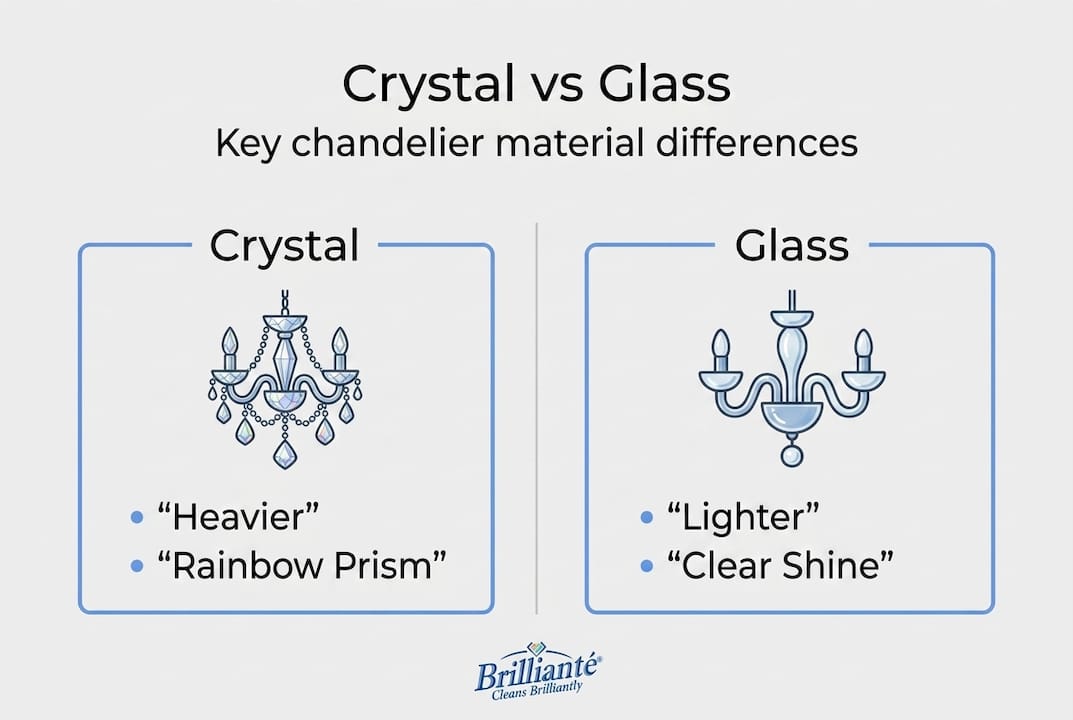
- Crystal is heavier than it appears and produces a clear ringing tone when tapped gently
- Glass is lighter, produces a dull thud when tapped, and has less brilliance
- Crystal refracts light into rainbow prisms; glass transmits light more directly without that spectrum effect
- Crystal edges feel sharp and precise; glass edges tend to be slightly smoother
In chandeliers, crystal is typically used in high-end fixtures where maximum light dispersion is the goal. Glass is common in mid-range or modern designs where clarity and clean lines matter more than dazzling refraction.
Why identifying your material matters: Using an acidic cleaner like vinegar on crystal can slowly etch the surface and destroy the very sparkle you are trying to restore. The cleaning checklist for crystal chandeliers at Brilliante walks you through material identification before you ever pick up a cloth.
Here is a quick comparison to guide you:
| Feature | Crystal | Glass |
|—|—|—|
| Weight | Heavier | Lighter |
| Light effect | Prismatic rainbow | Clear transmission |
| Sound when tapped | Clear ring | Dull thud |
| Cleaning sensitivity | High (no acid) | Moderate |
| Typical chandelier type | Luxury/traditional | Modern/mid-range |
According to cleaning method guidance, the three core approaches for crystal are spray-and-drip using a distilled water and isopropyl mix, hand-washing after disassembly with lukewarm mild soapy water followed by a distilled water rinse, and light dusting with a microfiber cloth or feather duster. Each method serves a different level of soiling and fixture complexity.
Why cleaning methods matter: Risks and rewards
Now that you can tell crystal and glass apart, it is crucial to know that they also require very different cleaning methods and precautions.
The biggest mistake homeowners make is reaching for the same all-purpose cleaner for everything. What works beautifully on glass can be genuinely destructive on crystal. Vinegar is a perfect example. It cuts through grime on plain glass surfaces without much risk. But on crystal, repeated use slowly etches the surface at a microscopic level, creating a permanent haze that no amount of polishing can fix.
“LEDs cut cleaning needs by halving heat and dust bake-on, while vinegar is fine for glass but etches crystal long-term. Expert consensus strongly favors crystal-specific cleaners for crystal fixtures.”
Safe cleaning solutions by material:
- Crystal: Distilled water with isopropyl alcohol, or a purpose-made crystal cleaner like Brilliante. Avoid vinegar, bleach, or abrasive sprays.
- Glass: Mild dish soap diluted in warm water, or standard glass cleaner. Vinegar dilutions work fine for light buildup.
- Both: Always use lint-free or microfiber cloths. Never use paper towels, which can scratch.
Lighting type also plays a bigger role in cleaning frequency than most people realize. Incandescent bulbs run hot and literally bake dust onto crystal surfaces, making it sticky and harder to remove. LED bulbs run much cooler, which means dust stays loose and easier to remove with light dusting. If you recently switched to LEDs, you may find your dazzling crystal fixtures need deep cleaning less often.
Pro Tip: Before you apply any cleaner, always test it on a single, inconspicuous crystal or glass piece. Wait 10 minutes and check for cloudiness, discoloration, or texture changes. This one-minute step can save an entire chandelier.
Step-by-step: Cleaning crystal and glass chandeliers safely
Knowing the importance of material-specific care, here is a simple, practical step-by-step for keeping both crystal and glass fixtures stunning and damage-free.
Supplies you need before starting:
- Soft microfiber cloths (at least 4 for a medium fixture)
- A purpose-made crystal cleaner OR diluted mild dish soap for glass
- Distilled water for rinsing crystal
- A plastic tray or towel to catch drips
- A stable ladder and a helper if the fixture is large
- Rubber gloves to prevent fingerprints
Cleaning steps for crystal:
- Turn off power and let bulbs cool completely (at least 30 minutes)
- Photograph the chandelier from multiple angles before removing anything
- For light dust, use a dry microfiber cloth or feather duster, working top to bottom
- For moderate soil, use the spray-and-drip method: spray crystal-specific cleaner directly onto each piece and let it drip dry onto your catch tray below
- For heavy soil, disassemble and hand-wash each piece in lukewarm water with a drop of mild soap, rinse with distilled water, and air-dry on a lint-free cloth
For glass chandeliers: Skip the disassembly unless absolutely necessary. A damp microfiber cloth with diluted dish soap, wiped gently and followed by a dry buff, handles most buildup effectively.

| Situation | Best method | Frequency |
|---|---|---|
| Light dust only | Dry microfiber dusting | Every 1-3 months |
| Moderate haze or film | Spray-and-drip (crystal) or damp wipe (glass) | Every 3-6 months |
| Heavy buildup or kitchen proximity | Full disassembly and hand-wash | Every 6-12 months |
| LED bulb fixture | Dry dusting extended interval | Every 2-4 months |
As cleaning frequency research confirms, light dusting every 1-3 months and deep cleaning every 3-12 months based on dust levels, heat exposure, and kitchen proximity is the practical sweet spot for most homeowners. Crystal fixtures in high-traffic chandelier environments near kitchens or fireplaces need more frequent attention.
Pro Tip: Never rub crystal dry. Instead, let it air-dry completely or dab very gently with a lint-free cloth. Rubbing creates micro-scratches that accumulate over years and permanently reduce brilliance.
Expert advice to keep your chandelier dazzling year-round
Having tackled foundational cleaning, it is worth exploring organization strategies and maintenance wisdom from professionals for ongoing brilliance.
One of the most practical things you can do before any cleaning session is take a photograph. It sounds almost too simple, but photo documentation prevents roughly 80% of reassembly errors. A good photo shows exactly where each arm, crystal, and chain was positioned before you touched anything.
Signs it is time for more than just dusting:
- Light output feels dimmer even with fresh bulbs
- A gray or yellowish film is visible on crystal pieces
- You can write in the dust on top of the fixture canopy
- Crystal pieces have lost their prismatic rainbow effect
- There is a faint oily residue (common near kitchens or candles)
Professional ultrasonic cleaning is worth knowing about. Ultrasonic cleaners use high-frequency sound waves to create microscopic bubbles that scrub into tiny crevices no cloth can reach. This is especially useful for antique or heavily ornamented fixtures. While expensive, professional ultrasonic cleaning can restore fixtures that look permanently dull. For most homeowners, however, a consistent checklist-based DIY routine handles 95% of maintenance needs beautifully.
Creating a simple maintenance schedule protects the financial value of your chandelier, too. A quality crystal chandelier can be worth thousands of dollars, and proper care preserves both its beauty and its resale value.
Pro Tip: Use a labeled tray system when disassembling. Place each type of crystal piece in its own section so reassembly takes minutes instead of guesswork. Your future self will thank you.
For a full structured routine, using a keep chandeliers dazzling guide as a reference helps you stay consistent without over-cleaning.
The overlooked truth about chandelier care: What most guides miss
Beyond expert tricks and routines, here is a perspective that might just change how you approach chandelier care for good.
Most people obsess over what to clean with. They debate brands, DIY recipes, and the merits of different cloths. But the real damage usually comes from when and how you clean, not what you use. Over-cleaning crystal is a genuine problem. Handling crystal pieces too frequently introduces oils, micro-abrasions, and stress on the wire loops that hold them in place. The goal is not a spotless chandelier every month. The goal is a sustainable routine that protects the fixture for decades.
The homeowners who get the best results long-term are almost always the ones who use a crystal chandelier cleaning checklist religiously, clean at the right frequency for their specific environment, and resist the urge to over-intervene. Organization and consistency beat aggressive cleaning every time. Perfection is not the target. Longevity is.
Take your chandelier care further with Brilliante
If you want even greater results, turn to resources designed just for chandelier owners.

Brilliante makes it easy to care for your crystal chandelier the right way, no matter the size or style. Our Drip-Dry formula is proudly made in the USA, non-abrasive, and safe for metal fittings, so you never have to worry about accidental damage. Just spray, step back, and let it work. Beyond the product itself, the Brilliante chandelier cleaning solutions library is packed with expert guides for every scenario. If you want a trusted starting point for your cleaning routine, visit our detailed resource to keep your chandelier dazzling and discover why hundreds of homeowners rate us number one.
Frequently asked questions
How can I tell if my chandelier is crystal or glass?
Crystal feels heavier, reflects prismatic rainbow light, and produces a clear ring when tapped gently. Glass is lighter, less brilliant, and makes a dull sound. Material density and refraction are the key distinguishing factors.
Is vinegar safe for cleaning chandeliers?
Vinegar works safely on plain glass but should never be used on crystal. Repeated use etches crystal surfaces and causes permanent clouding that cannot be reversed.
How often should I clean my chandelier?
Dust lightly every 1-3 months and schedule a deep clean every 3-12 months. Your specific cleaning frequency depends on proximity to heat sources, kitchens, and how quickly dust accumulates in your home.
Should I hire a professional to clean my chandelier?
If your fixture is antique, extremely large, or heavily soiled in tight crevices, a professional ultrasonic cleaning may be the safest choice. Most homeowners find that DIY with checklists handles routine maintenance effectively without professional help.