
Crystal vs Glass: the Difference Every Collector Should Know
TL;DR:
- Crystal differs from glass in composition, containing added metal oxides like lead or substitutes, which enhances its brilliance and weight. Practical tests such as light dispersion, sound, and weight help distinguish them at home, with crystal showing vivid rainbows, a melodious ring, and heavier feel. For safety and practicality, choose lead-free crystal for daily use and reserve lead crystal for occasional display or special occasions.
Most people assume “crystal” and “glass” are simply two words for the same thing. They are not. Understanding the difference between crystal and glass matters whether you are shopping for stemware, identifying a vintage find at an estate sale, or deciding which chandelier to hang in your dining room. The two materials look similar at a glance, but they differ in composition, weight, light behavior, and even health implications. Once you know what to look for, you will never confuse them again.
Key takeaways
| Point | Details |
|---|---|
| Crystal contains added minerals | Lead oxide or modern substitutes like barium and zinc oxide give crystal its signature weight and brilliance. |
| Neither material is truly crystalline | Both glass and crystal are amorphous solids with no periodic atomic lattice, despite the name. |
| Physical tests work best in combination | Sound, weight, and light refraction tests together give more reliable results than any single method. |
| Lead crystal carries health risks | Long-term storage of acidic beverages in lead crystal can cause lead to leach into the liquid. |
| Modern lead-free crystal is a smart choice | Barium and zinc oxide formulas deliver optical brilliance without lead exposure concerns. |
The difference between crystal and glass, explained at the material level
Here is something that surprises most people: “crystal” is not a scientific category. Both glass and crystal are amorphous solids, meaning neither has the repeating atomic structure that true crystals like quartz or diamond possess. The word “crystal” on a wine glass or chandelier pendant is largely a quality and marketing designation, not a chemistry term.
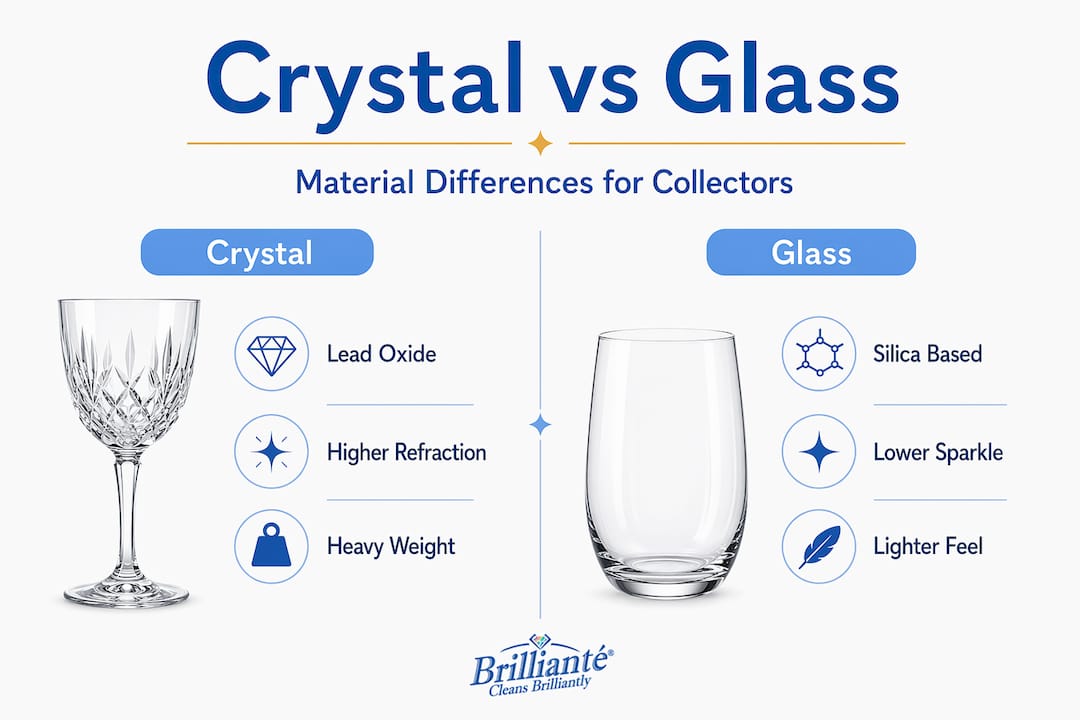
So what actually separates them? Composition. Standard glass is made primarily from silica (sand), soda ash, and limestone. Crystal starts with the same silica base but adds metal oxides that change its optical and physical properties significantly. Traditional lead crystal must contain at least 24% lead oxide in the EU to carry that designation, which pushes its refractive index up to 1.7 compared to roughly 1.5 for ordinary glass.
That higher refractive index is why crystal catches and bends light so dramatically. The density of lead crystal often exceeds 2.9 g/cm³, while standard glass sits around 2.5 g/cm³. You feel that difference the moment you pick up a crystal wine glass versus a standard one. The crystal piece is noticeably heavier for its size.
Modern manufacturers have largely moved away from lead. Lead-free crystal uses barium oxide, zinc oxide, or potassium oxide to replicate the optical brilliance and workability of lead crystal without the health concerns. These alternatives achieve a similar refractive index and allow the same intricate cutting that defines high-end crystal pieces. For collectors buying new pieces in 2026, lead-free crystal is now the standard from most reputable makers.
| Property | Standard glass | Lead crystal | Lead-free crystal |
|---|---|---|---|
| Refractive index | ~1.5 | Up to 1.7 | ~1.55 to 1.62 |
| Density | ~2.5 g/cm³ | >2.9 g/cm³ | ~2.7 to 2.9 g/cm³ |
| Lead content | None | 24% or more | None |
| Brilliance | Moderate | Very high | High |
| Dishwasher safe | Usually yes | Often no | Often no |
Pro Tip: When shopping for crystal, look for labels that specify “lead-free crystal” or list the substituting oxide. The word “crystal” alone tells you very little about the actual composition.
How to tell crystal from glass at home
You do not need a lab. Several practical tests can point you in the right direction, and using multiple tests together will give you a far more reliable answer than relying on just one.
The light test. Hold the piece near a light source or window. Crystal’s higher refractive index produces vivid, rainbow-colored light dispersion across nearby surfaces. Standard glass produces a weaker, less colorful effect. The prism test is one of the most visually dramatic ways to see this difference. Crystal essentially acts like a prism; glass does not.
The sound test. Tap the rim of the piece gently with your fingernail or lightly flick it. Crystal produces a clear, bell-like ring with noticeable sustain. Glass gives a dull, short clink. This test works well on goblets and vases but can be less reliable on thick or very small pieces where mass affects the sound.
The weight test. Pick it up. Crystal, especially lead crystal, feels surprisingly heavy for its apparent size. If a thin-walled glass feels like it should weigh nothing but has real heft to it, that is a strong indicator of crystal.
The rim and wall thickness. Crystal can be made thinner than glass while maintaining strength, because the added mineral oxides lower the melting point and allow for finer workmanship. A rim so thin it almost seems fragile, combined with weight, is a classic crystal signature. You can learn more about identifying crystal at home with additional visual guides.
Here is a quick summary of what to check:
- Light dispersion: vivid rainbows suggest crystal; pale or no color suggests glass
- Sound: melodious ring with echo is crystal; short dull clink is glass
- Weight: heavier than expected for its size points to crystal
- Rim thickness: very thin, almost delicate edges are common in crystal
- UV light: some crystal pieces exhibit slight fluorescence under UV light
Pro Tip: Never base your identification on sound alone. A thick crystal bowl and a thin glass vase can sound surprisingly similar. Combine the weight, light, and rim tests before drawing a conclusion.
Crystal vs glass in home decor and collectibles
The differences in materials show up clearly once you look at how each one is designed and manufactured. For home decorators and collectors, these aesthetic and structural contrasts matter as much as the science behind them.
Cut quality and surface detail
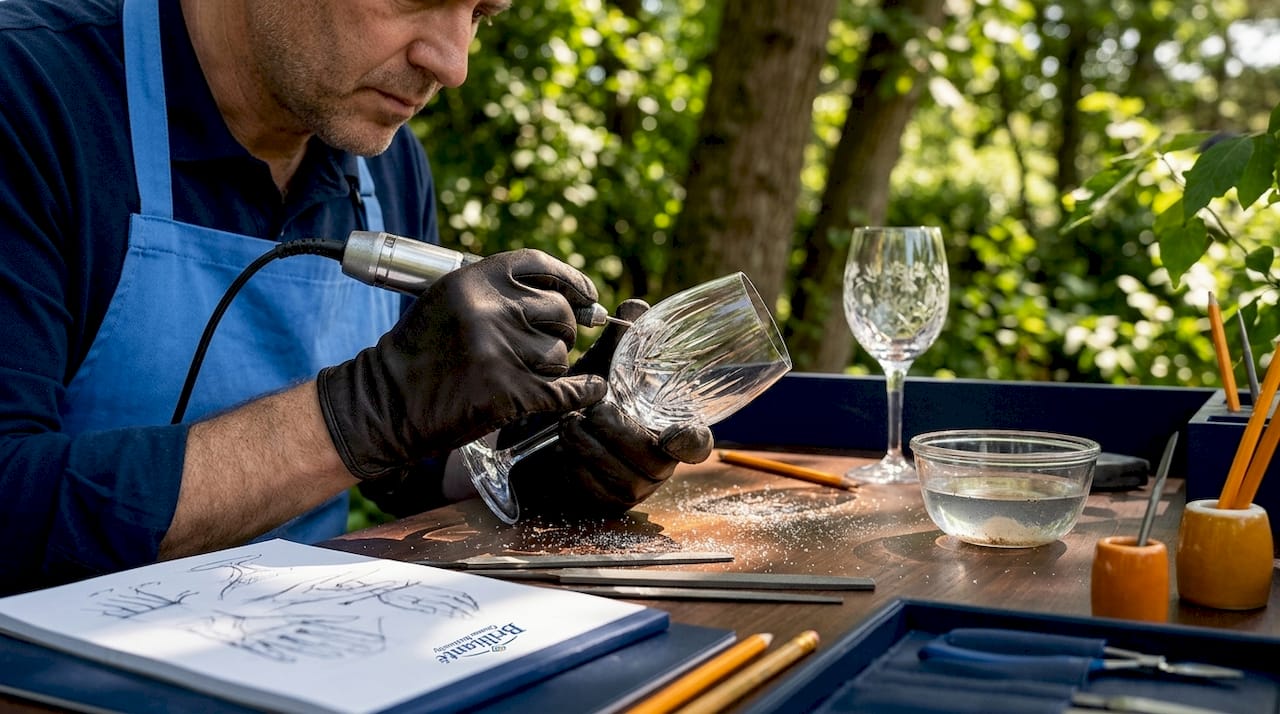
Crystal takes cuts more precisely than glass because lead oxide lowers the glass mixture’s melting point, making it easier to work with and allowing finer, thinner designs. The facets on a cut crystal vase or chandelier pendant are sharp, geometric, and catch light at distinct angles. Glass cutting tends to produce softer edges and less intricate patterns. When you run your finger along cut crystal, the edges feel crisp rather than rounded.
Mold seams and surface characteristics
Machine-made glass pieces often have a faint seam running along the side where two mold halves met during production. Handcrafted crystal rarely shows this seam. Instead, you might notice subtle imperfections that are actually marks of authenticity. Traditional lead crystal can contain small bubbles, cord, and microscopic stone inclusions as natural results of the hand-manufacturing process. These are not defects. They authenticate the piece. Cord appears as a faint wispy distortion inside the glass; stone inclusions are tiny embedded ceramic flecks.
| Feature | Machine-made glass | Handcrafted crystal |
|---|---|---|
| Cut edges | Softer, rounded | Sharp, precise |
| Surface seams | Often visible | Rarely present |
| Internal inclusions | Rare | Possible (cord, bubbles) |
| Rim thickness | Thicker, uniform | Thin, delicate |
| Color tint | May have greenish cast | Clear or very slight gray |
Color clarity over time
Standard glass often carries a faint greenish or bluish tint, most visible when looking at the edge of a thick piece. Crystal tends toward a clearer, brighter appearance. This is one of the subtler differences in glassware vs crystal that becomes more obvious when you place the two side by side.
Health, safety, and care for crystal and glass
Knowing what your pieces are made of changes how you should use and maintain them. This is especially true for lead crystal.
-
Avoid long-term storage of acidic beverages in lead crystal. Lead can leach into wine, spirits, or juice when stored in contact with lead crystal for extended periods. Decanters are particularly risky if you leave wine or port sitting in them for days or weeks. Use your lead crystal decanters for serving, not storing.
-
Reserve older lead crystal pieces for display or occasional use. Vintage decanters and stemware from pre-2000 collections are often beautiful but may contain significant lead content. Displaying them in a cabinet rather than drinking from them regularly is the safer approach.
-
Choose lead-free crystal for everyday use. Modern lead-free crystal offers the same optical qualities and benefits of crystal without lead exposure risk. For daily wine glasses, water goblets, or pieces you use frequently, current lead-free options are the practical answer.
-
Hand wash both crystal and glass to preserve clarity. Dishwashers cause etching, clouding, and micro-scratches over time, particularly on crystal. The high heat and harsh detergents degrade the surface. Warm water and a mild dish soap applied with a soft cloth is the better method. For more detailed guidance, the care guide for crystal and glass covers this thoroughly.
-
Dry crystal pieces immediately after washing. Leaving crystal to air dry allows mineral deposits from tap water to form on the surface. A lint-free microfiber cloth prevents spotting and keeps the material looking its best.
My honest take on the crystal vs glass debate
I have spent years around crystal, and one thing I keep noticing is that people treat “crystal” as automatically better than glass. That assumption deserves a closer look.
In my experience, the benefits of crystal are real but specific. The light dispersion and acoustic ring of a fine crystal wine glass are genuinely different from glass. For chandeliers, crystal pendants catch light in a way that no glass alternative fully replicates. I would not trade quality crystal chandelier drops for glass ones.
But here is what most collectors miss: a beautifully crafted piece of glass with excellent clarity can outperform cheap crystal in both looks and function. The word “crystal” on a label means nothing without the quality of workmanship behind it. I have seen mass-produced “crystal” bowls that showed less brilliance than a thoughtfully made hand-blown glass vase.
The other thing people overlook is that what makes glass unique in its own right. Modern high-clarity glass, tempered glass, and borosilicate glass have properties that make them better suited for specific uses than crystal. They are generally more dishwasher safe, more thermally resistant, and more practical for daily use.
My honest recommendation is this: choose crystal for display, entertaining, and pieces where light and elegance are the point. Choose quality glass for everyday use where durability matters more. And never pay a premium for the word “crystal” without checking what actually gives the piece its characteristics.
— BCC
Keep your crystal and glass looking their best
If you have gone through the work of identifying and choosing the right pieces for your home, the last thing you want is for dull spots or residue to hide their beauty.
Brilliantecrystalcleaner’s drip-dry formula is made specifically for crystal chandelier cleaning and works on glass surfaces too. Spray it on, let it drip dry, and the solution lifts dust and residue without leaving water spots or streaks. It is non-abrasive, environmentally friendly, and will not tarnish metal hardware. Whether you have a lead crystal chandelier or a contemporary lead-free installation, you can explore the full cleaning solution made in the USA and trusted by hundreds of satisfied customers to restore that original sparkle.
FAQ
What is the actual difference between crystal and glass?
Crystal is a type of glass that contains added metal oxides, traditionally lead oxide, which increase its density and refractive index. Standard glass is made from silica, soda ash, and limestone without these additives.
Is crystal pure glass?
No. Crystal is not pure glass. It starts with a silica base but includes significant amounts of lead oxide or modern substitutes like barium and zinc oxide that fundamentally change its optical and physical properties.
How can I tell crystal from glass without professional tools?
Use three tests together: tap the rim and listen for a clear musical ring, check the weight relative to its size, and hold it near light to look for vivid rainbow dispersion. A crystal piece will typically score on all three where glass will not.
Is lead crystal safe to use?
Lead crystal is safe for occasional use such as serving drinks at dinner. The health risk arises from long-term acidic liquid storage, which causes lead to leach. For everyday use, modern lead-free crystal is the better option.
Why does crystal sparkle more than glass?
Crystal’s higher refractive index, up to 1.7 compared to roughly 1.5 for standard glass, means it bends and disperses light more sharply. That is what produces the distinct rainbow patterns and sparkle that define quality crystal pieces.