
Spot crystal vs glass: homeowner's guide to chandelier care
TL;DR:
- Differentiating between crystal and glass chandeliers is vital for proper care, preservation, and safety.
- Homeowners should perform multiple simple tests, like sound, weight, refraction, and edge tint, for accurate identification.
Not every sparkling chandelier piece is the same, and treating them all identically is one of the most common mistakes homeowners make. Whether you just inherited a vintage fixture or installed something new, the difference between crystal and glass in your chandelier is not just about looks. It shapes how you clean, what products you choose, and how long your chandelier keeps that dazzling brilliance. This guide walks you through the real, practical differences between crystal and glass so you can care for your fixture with confidence and protect its sparkle for years to come.
Key Takeaways
| Point | Details |
|---|---|
| Multiple tests work best | No single trick reliably separates crystal from glass—use sound, sparkle, and weight together. |
| Modern materials complicate ID | Lead-free crystal and premium glass can resemble each other closely, requiring careful observation. |
| Right care protects value | Knowing your chandelier’s material lets you safely clean and extend its life. |
| Avoid harsh cleaning methods | Using the wrong cleaners or techniques can damage both crystal and glass fixtures. |
Why distinguishing crystal from glass matters for your chandelier
At first glance, a glass chandelier and a crystal chandelier can look nearly identical. Both catch the light. Both scatter brightness around a room. But the moment you pick up a cleaning cloth or reach for a spray bottle, the difference becomes critical.
Crystal is a denser, more refined material. It typically contains minerals that increase its refractive index, meaning it bends and splits light more dramatically than standard glass. That’s why a genuine crystal chandelier can fill a room with tiny rainbows on a sunny afternoon. It’s also more delicate and more valuable. Cleaning it with the wrong product or technique can etch the surface, reduce its clarity, or cause permanent damage.
Glass, by contrast, is more forgiving. It’s generally more durable, less porous on a microscopic level, and can tolerate a slightly wider range of cleaning solutions. Decorative glass can look impressive, but it won’t have the same depth of sparkle or refraction as true crystal.
Here’s why getting this right matters so much for your specific fixture:
- Value protection: Crystal chandeliers can represent a significant investment. Treating them the way you’d treat a basic glass piece risks scratching or dulling an irreplaceable surface.
- Shine maintenance: The wrong cleaner can leave residue or micro-abrasions that permanently cloud crystal, stripping the brilliance that makes your fixture a focal point.
- Safety: Crystal pieces are often thinner and more delicate at the edges. Aggressive scrubbing can chip or crack them.
- Long-term upkeep: Understanding what material you have helps you build a cleaning routine that preserves, rather than diminishes, its appearance.
“Visual differences between crystal and glass can be subtle, and sparkle alone isn’t always a reliable indicator.” That means you can’t always trust your eyes alone.
Before you start any cleaning routine, it pays to know your material. Getting familiar with crystal versus glass basics is the smartest first step you can take for your chandelier.
With the stakes clear, let’s explore the fundamental differences between crystal and glass.
Crystal vs glass: Key physical differences you can spot at home
Understanding why it matters, now let’s break down how you can spot these differences yourself. The good news is that you don’t need any special equipment. You just need a few minutes and the right approach.
The tap test
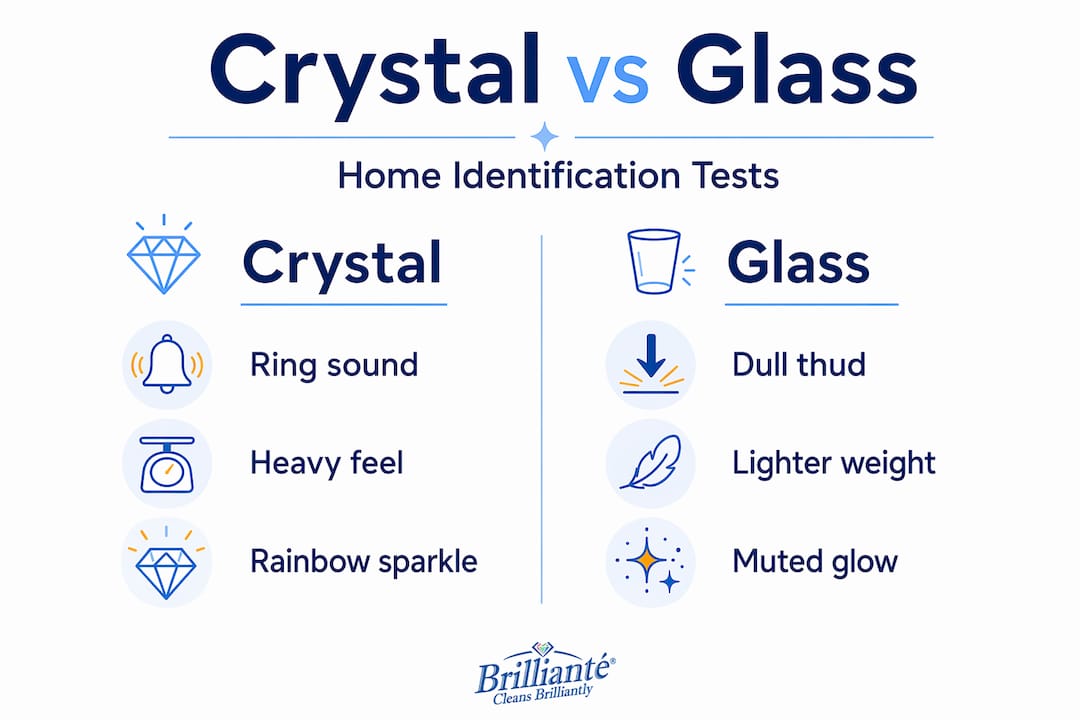
This is the single most reliable quick test you can perform. Gently tap the piece with your fingernail or a pencil. Crystal produces a sustained, bell-like ring that lingers for a moment. Standard glass gives a shorter, duller thud. The longer the ring hangs in the air, the more likely you’re dealing with crystal. Try it on several pieces from the same chandelier to confirm your results.
The weight test
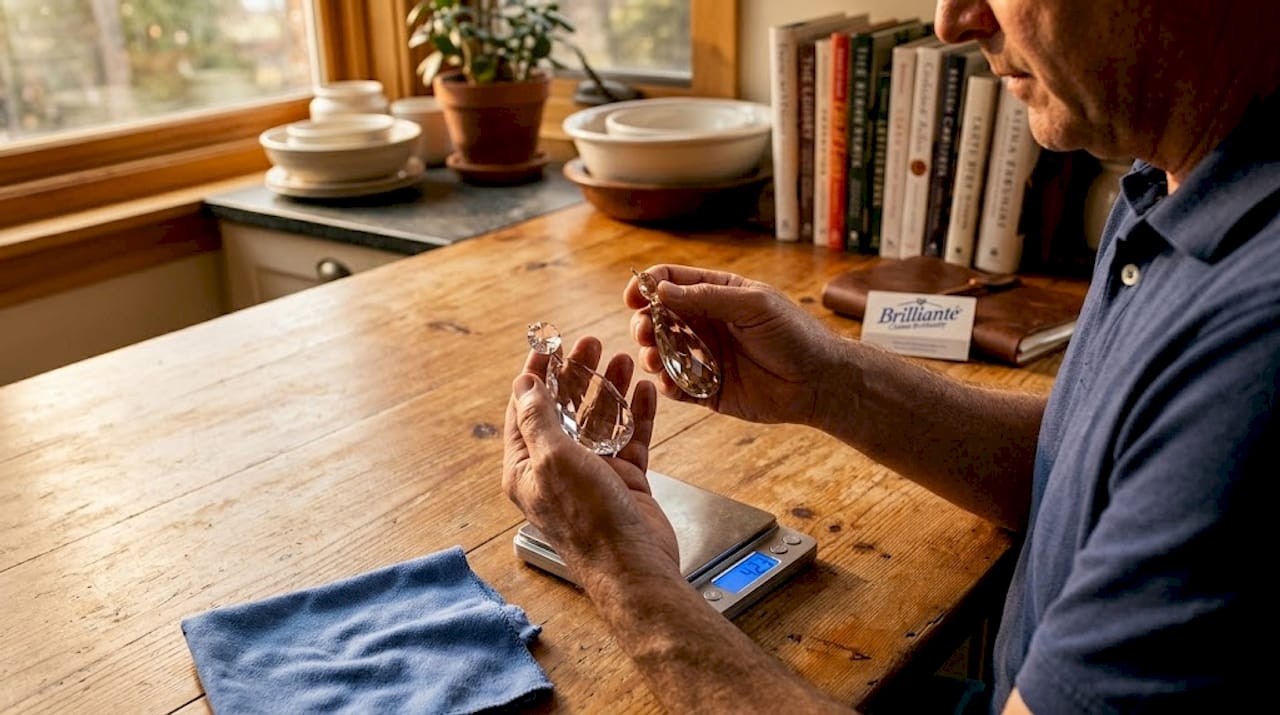
Hold a pendant piece in your palm. Crystal is noticeably heavier than glass of the same size. This is because crystal contains denser minerals. If a piece feels surprisingly light, especially for its visual bulk, it’s likely glass. Again, if you have access to multiple pendants, compare them. Even subtle differences in density become more obvious when you’re comparing side by side.
The refraction test
Hold a pendant up to natural light or near a lamp. Crystal will scatter light into visible prisms or tiny rainbows. Glass may glitter, but it rarely produces the same multi-colored, prismatic effect. Tilt the piece slowly in the light and watch what happens. A strong, colorful prism display points strongly toward crystal.
The clarity test
Look through the piece at a sharp edge like a window frame or a dark line. Crystal will appear exceptionally clear, with almost no color tinting. Standard glass often has a faint green or gray tint, especially when viewed from the edge. Hold the piece horizontally and look through it from the side to see this most clearly.
| Test | Crystal | Glass |
|---|---|---|
| Tap sound | Clear, sustained ring | Short, dull thud |
| Weight | Noticeably heavier | Lighter for same size |
| Refraction | Rainbows, visible prisms | Glitter, less color |
| Edge tint | Clear, no tint | Faint green or gray |
| Clarity | Very clear | Slight cloudiness possible |
These chandelier identification tips work best when you combine two or three tests rather than relying on just one. Think of each test as a vote. The more votes that point to crystal, the more confident you can be in your identification.
Here is a step-by-step approach to get the most reliable result:
- Start with the tap test. It’s the easiest and quickest clue.
- Follow up with the weight test. Compare several pieces if you can.
- Use the refraction test in natural light for a visual confirmation.
- Check the edge tint as a tiebreaker if you’re still unsure.
- Look for any manufacturer markings, labels, or stamps on the fixture hardware or box.
Pro Tip: If your chandelier came with original packaging or documentation, check the paperwork first. Manufacturers often label crystal pieces specifically. This single step can save you a lot of guesswork.
Knowing about identifying and caring for crystal before you start cleaning will save you time, money, and frustration. As noted by lighting experts, visual differences can be subtle so sparkle strength should be treated as one clue among several, not a final answer.
Modern crystal versus decorative glass: Navigating the gray areas
Simple identification methods work in most cases, but let’s look at trickier scenarios involving modern materials.
The chandelier market has changed dramatically in recent decades. Traditional crystal contained lead oxide, which gave it exceptional density, weight, and brilliance. Lead crystal is still prized, but health and environmental regulations have pushed manufacturers toward lead-free alternatives. These modern crystals are made using different minerals like barium oxide or zinc oxide to achieve similar optical effects without the lead content.
This creates a real challenge for homeowners. Modern lead-free crystal can retain sparkle and optical effects that complicate standard tests. In other words, a lead-free crystal piece might ring slightly differently than traditional crystal, or it might weigh less than you expect. Meanwhile, high-quality decorative glass is increasingly made to mimic crystal’s prismatic qualities, adding another layer of confusion.
Here’s how to navigate these murkier waters:
- Check for labeling: Many reputable manufacturers label their pieces as “lead-free crystal,” “K9 crystal,” or “optical glass.” These terms matter. K9 crystal is a specific optical-grade glass that behaves much like traditional crystal.
- Look at price and origin: Genuine crystal chandeliers from established European or reputable American manufacturers are almost always labeled and documented. Budget chandeliers marketed as “crystal” are frequently high-quality glass.
- Combine your tests: No single test is definitive for modern materials. Use the tap test, weight test, and refraction test together and weigh all three results.
- Consult the retailer: If you purchased your chandelier recently, contact the retailer or manufacturer directly. They can tell you exactly what material was used.
| Material | Lead content | Typical weight | Prism effect | Tap sound |
|---|---|---|---|---|
| Traditional lead crystal | Yes (24%+ lead oxide) | Heavy | Strong | Clear, long ring |
| Lead-free crystal | No | Moderate | Good | Moderate ring |
| Optical glass (K9) | No | Moderate | Good | Short ring |
| Standard decorative glass | No | Light | Minimal | Dull thud |
Pro Tip: When in doubt, check the metal framework of your chandelier for any maker’s marks or country of origin stamps. European fixtures, particularly those from Czech or Austrian manufacturers, are far more likely to feature genuine crystal components.
You can read more about lead crystal vs glass choices and learn what different materials mean for your home. For a deeper background, a lead crystal overview explains the history and characteristics that still define the category today.
How to apply your knowledge: Cleaning and caring for crystal and glass
Now that you know how to identify each material, here’s how this knowledge helps you protect and enhance your fixture.
The identification process is not just an academic exercise. It directly shapes every cleaning decision you make. Crystal and glass require different cleaning and care regimens to preserve appearance and longevity. Using a product designed for one on the other is a shortcut to disappointing results.
Follow these steps to clean your chandelier correctly based on its material:
- Identify first, clean second. Use the tests described above to confirm whether your fixture is crystal, lead-free crystal, or glass before choosing any product.
- For crystal: Always use a non-abrasive, gentle cleaner formulated specifically for crystal. Avoid anything with ammonia, bleach, or abrasive compounds. These chemicals can etch the surface and permanently reduce clarity.
- For glass: Glass is more tolerant, but you should still avoid harsh scrubbing. A gentle glass-safe formula works well. Avoid soaking metal hardware in any liquid, as tarnishing is a real risk.
- Minimize handling: Oils from your hands can leave smudges and residue. If you must handle the pieces during cleaning, wear thin cotton gloves.
- Allow proper drying: Crystal especially benefits from a drip-dry approach rather than wiping, which can introduce micro-scratches. Glass can be lightly patted dry with a lint-free cloth if needed.
- Work top to bottom: Always clean from the top of the fixture downward to avoid re-dripping dirty solution onto already-cleaned pieces.
“The right cleaner is not just about getting things shiny. It’s about protecting the material from the inside out, preserving both the surface and the structure of each piece.”
Pro Tip: Before cleaning the whole chandelier, test your chosen product on a single piece or a hidden area first. Wait a few minutes and check for any cloudiness, reaction, or residue. This single test can save you from damaging an entire fixture.
Learning about cleaning chandeliers safely gives you a complete picture of what each material needs, from daily dusting to occasional deep cleans.
The real challenge: Why most homeowners still get it wrong
Here is an opinion that might surprise you: the tap test, the weight test, and the sparkle check are all excellent tools, but they still leave room for error. Most homeowners get identification wrong not because they skip the tests, but because they trust a single test too much. They tap the pendant, hear a decent ring, and declare it crystal. Or they see lots of sparkle and assume the same. One clue is never enough.
The deeper truth is that identifying crystal versus glass is a process of building evidence, not a one-step answer. The market today is full of materials designed to blur the line intentionally. Manufacturers know that “crystal” carries prestige, so they engineer decorative glass to ring a little clearer, sparkle a little brighter, and feel a little heavier. These materials are not bad. They can be beautiful. But they are not the same as genuine crystal, and they respond differently to cleaning.
What actually works is treating identification like a checklist, not a single question. Run at least three tests. Compare multiple pieces from the same fixture. Check for documentation. Look for maker’s marks. And if you genuinely cannot tell, treat the material like crystal because the more careful approach is always safer. You’re far less likely to damage a glass chandelier by using a crystal-safe cleaner than you are to damage a crystal chandelier with something too harsh.
There’s also a common misconception that older automatically means better crystal. Age alone is not a reliable indicator. Many vintage fixtures from certain decades used glass throughout, while some newer chandeliers use exceptional-quality lead-free crystal. What matters is the material, not the age. Stay curious about your specific fixture rather than making assumptions based on how old or expensive it looks.
If you want to avoid the most common crystal vs glass pitfalls, approach every chandelier as its own puzzle. The homeowners who keep their fixtures gleaming for decades are the ones who ask questions first, clean second.
Take chandelier care further with expert support
Knowing whether you have crystal or glass is the essential first step, and now you’re ahead of most homeowners who skip it entirely. Proper identification protects your investment and keeps your chandelier looking extraordinary year after year.
Brilliante Crystal Chandelier Cleaner makes the cleaning step just as straightforward. Our specially formulated, drip-dry solution is proudly made in the USA. Just spray it on and let it do the work. No rubbing, no rinsing, no risk of scratching your delicate crystal or dulling your glass. It’s non-abrasive, environmentally friendly, and will not tarnish your metal hardware. Hundreds of satisfied homeowners have rated it the number one choice for chandelier care. For even more guidance, explore our detailed crystal vs glass guide so you can shop, clean, and maintain with total confidence.
Frequently asked questions
What is the simplest test to tell crystal from glass?
Tap the object gently with your fingernail. Crystal will produce a clear, bell-like ring that lingers, while glass gives a shorter and duller sound.
Can you tell if a chandelier is crystal just by its sparkle?
Sparkle is a helpful clue, but it is not conclusive on its own. Premium decorative glass can produce impressive brilliance, so always combine sparkle observation with other physical tests.
Does modern crystal always contain lead?
No. Many modern crystal chandeliers are lead-free but still have excellent brilliance. Lead-free crystal can retain optical effects similar to traditional lead crystal, so a lead test alone won’t give you the full picture.
Will cleaning methods damage crystal if used on glass, or vice versa?
Yes, using the wrong method can cause real harm. Crystal and glass require different care regimens, and harsh products or abrasive techniques designed for one can reduce shine or cause damage to the other.